The Career I Never Planned
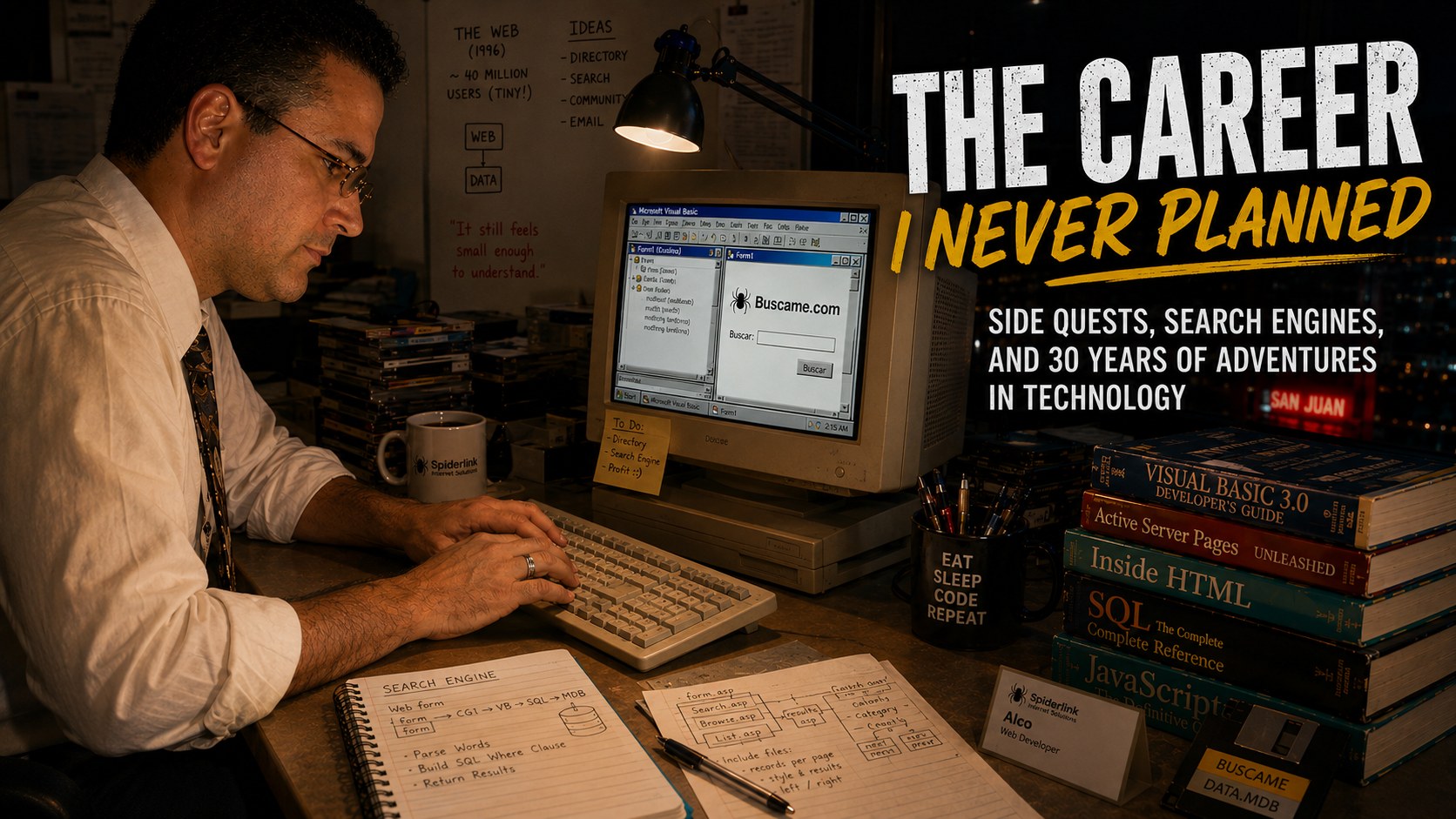
In high school, all I wanted was to not be there.
Every morning felt like being sent somewhere I didn't want to go. I wasn't dreaming about a career in technology. Honestly, I wasn't dreaming about careers at all.
When I took the College Board exams, I ended up with the highest score in my school that year. Somewhere in the paperwork, I had listed Computer Science as my first option.
I didn't think much about it.
I did my first year of college and dropped out.
I became a bartender. I spent a lot of time around music, nightlife, and magic. At that point, becoming a software engineer was nowhere in the story I imagined for myself.
Then life started becoming more real.
I met the woman who would later become my wife. The future stopped feeling abstract.
I decided to return to college — not because I had suddenly discovered a passion for Computer Science, but because formal education started to feel important in a different way.
I dug through my old papers and found my College Board results.
Computer Science.
So I picked it.
I had no idea that decision would quietly shape the next 30 years of my life.
Looking back, I realize I never hated learning.
I hated confinement.
I hated the idea that education was something that only happened inside classrooms, on schedules decided by someone else.
And I hated the feeling that I was constantly being told what was important to learn while the things I was naturally curious about were treated as distractions.
The most important things I learned in my life rarely came from formal instruction.
They came from curiosity.
From books. From experiments. From failed projects. From late nights. From mailing lists. From musicians. From magicians. From building things that probably shouldn't have worked.
Education, to me, stopped being a place a long time ago.
It became a way of moving through life.
In 1996, someone at the university convinced me to send a résumé to a small internet company called Spiderlink.
I didn't really see myself working for a company. I imagined clients. Small projects. Maybe building systems for businesses on my own.
But they hired me on the spot.
I still remember walking into the office on my first day.
The people there — maybe three or four — all dressed the same way: long sleeves, tie, tucked-in shirts.
Professional.
So I showed up dressed like a 24-year-old trying very hard to look like an adult computer professional.
Which, to be fair, is exactly what I was.
Then they gave me my own office.
My own desk.
A computer.
I couldn't believe it.
The web in 1996 was tiny.
Not small compared to today.
Tiny.
The entire internet had fewer users than many modern cities.
In Puerto Rico, the numbers were even smaller. The island had around 3.7 million people, but internet penetration in 1996 was estimated at roughly 0.27% — meaning maybe 10,000 people in the entire territory were online. I was one of them.
It still felt possible for a small group of curious people to understand the whole thing.
Most people didn't even have computers at home. I certainly didn't have the kind of setup where I could wake up at 2AM and test an idea.
So the problems followed me home.
Sometimes I'd wake up in the middle of the night with a possible solution to something I had been debugging all day. There was no way to test it.
No remote login. No cloud environment. No AI assistant.
Just a thought.
I'd get up, write the idea down on paper, and wait until the next morning to find out whether my brain had actually solved the problem or was hallucinating nonsense at 3AM.
Honestly, that delay may have made me a better programmer.
I was the company's only web developer.
Which sounds impressive until you remember what "the web" looked like in 1996.
HTML was extremely limited. There were no modern frameworks, no Stack Overflow, no YouTube tutorials.
And I didn't think of web development as a creative field.
To me, it was pure technical work.
I had no awareness of tools like Photoshop or CorelDRAW yet. If I needed to edit a graphic, I opened Microsoft Paint and modified the image pixel by pixel.
In BMP format.
That sentence alone probably carbon-dates me.
Within about a year, I was suddenly responsible for building a team. My title became "Internet Programming Director," which sounds both futuristic and completely made up by today's standards.
The truth is, none of us really knew what this industry was becoming yet.
There weren't established career paths for web developers because "web developer" wasn't even common terminology.
We were improvising the profession in real time.
One day my boss asked me to build a directory website.
Something like the original Yahoo.
I remember replying:
"Why don't we build a search engine?"
Which, in retrospect, was a pretty ambitious thing for a 24-year-old in Puerto Rico to casually suggest in 1996.
But the web still felt small back then. Search engines weren't giant corporations yet. They were ideas.
So I spent the next month trying to figure out how to take words entered into a web form and transform them into SQL queries against an Access MDB database.
That became Buscame.com.
(🥚 Easter egg: click that link, type anything in the search box, and hit "Buscame." You'll get a .exe not found error — because the search engine was a compiled Visual Basic executable running as a CGI script. The Wayback Machine preserved the page but not the binary. Twenty-eight years later, the error itself is the artifact.)
No frameworks. No APIs. No cloud services.
Just HTML forms, Visual Basic, CGI scripts, and a kid trying to make databases talk to websites.
By 2001, I had founded Aranay Interactive Systems.
Looking back, I realize I never stopped being the person I imagined at 24.
Even when I worked inside companies, I never fully saw myself as a corporate person.
I was always consulting. Always exploring. Always moving toward interesting problems.
The scale just kept changing.
Over the next 30 years, those adventures somehow took me far beyond anything that kid in Puerto Rico could have imagined: books, companies, Silicon Valley, Berlin, global conferences, mobile apps, open source advocacy, music, AI.
And yet, strangely, the feeling stayed almost the same.
Curiosity followed by experimentation.
That's still the process.
Today, after three decades in technology, I can generate software from a phone using natural language.
That sentence would have sounded like science fiction to the version of me debugging CGI scripts in 1996.
But the funny thing is that the deeper motivation never really changed.
I still wake up with ideas.
I still chase side quests.
I still get excited when systems connect in unexpected ways.
I thought I was choosing a profession.
What I was really choosing was a lifetime of adventures.
Those 1996 CGI scripts at Spiderlink eventually became my first book about programming the early web.
Thirty years later, the same craft turned into something that calls itself coding without actually being coding.
The Buscame.com ruins still living on the Wayback Machine are part of why I think creative work has a strange afterlife.
📬 Enjoyed this article?
Subscribe for the stuff that doesn't make it onto the blog — half-finished ideas, what I'm reading and listening to, behind-the-scenes notes, and the occasional rabbit hole. No spam, just things worth your time.