I Went Looking for a Composing Partner. I Ended Up Building One.
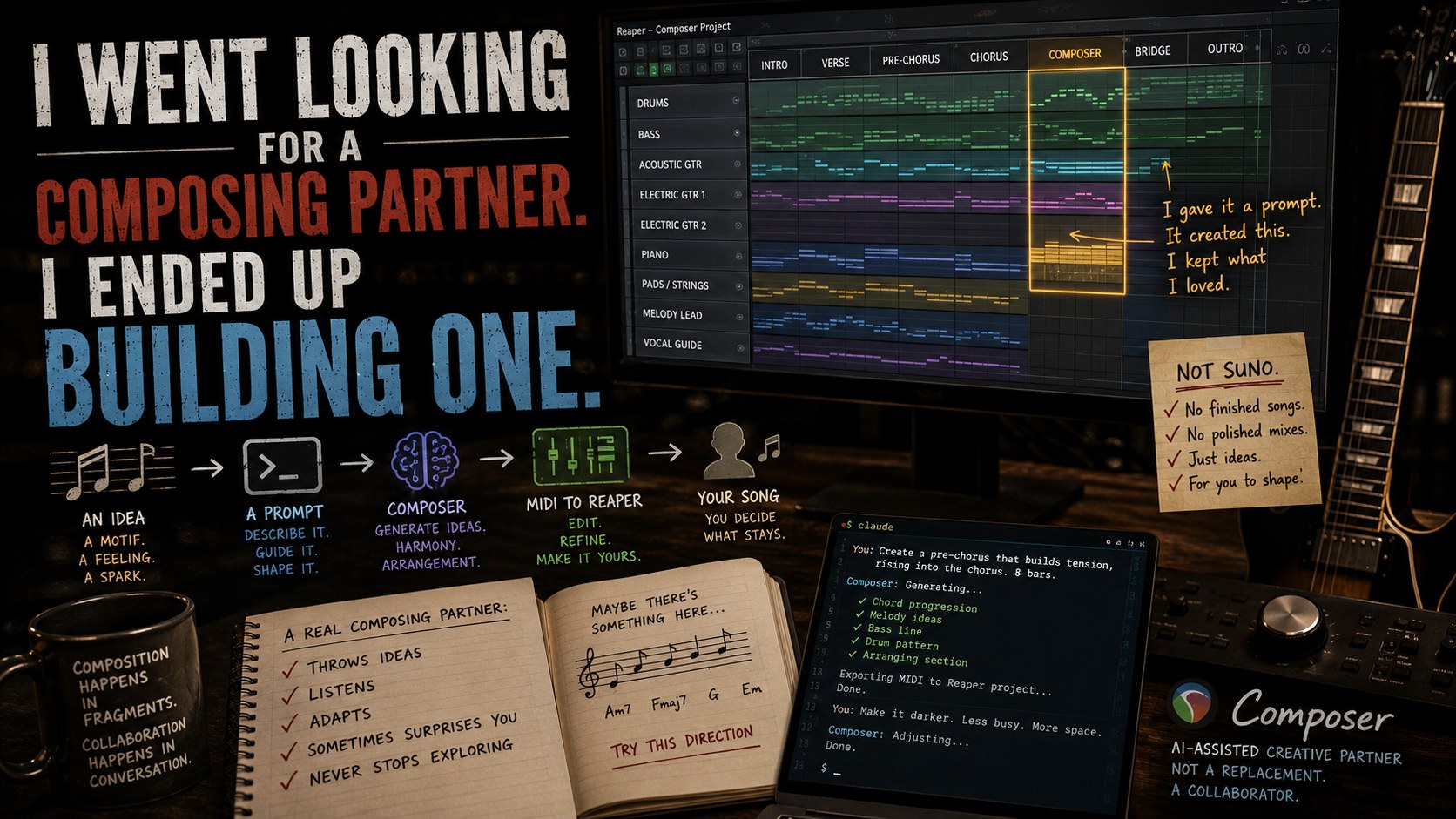
Ever since I decided to start composing original music seriously, I'd been looking for someone to collaborate with.
Not a producer.
Not someone to hire.
A creative partner.
Someone who could take a chord progression, a motif, half an arrangement idea — and push it somewhere unexpected.
I tried a few things.
Conversations with musicians. Late-night exchanges of rough demos. The usual "we should totally work on something together" messages that disappear after a week.
Nothing really clicked.
Part of the problem is that composition happens in fragments.
You don't send someone a finished specification.
You send a strange four-bar loop at 11:30 PM and say:
"I think there's something here."
Most collaborations never survive that stage.
There's also something I don't usually admit.
When I was learning guitar, I skipped learning songs.
I went straight into technique, theory, improvisation — everything except sitting with someone else's music long enough to understand how songs were actually constructed.
That gap shows up now.
I can play. I can improvise.
But when I sit down to write, I sometimes realize I never fully developed a vocabulary for arrangement and composition the way people do when they spend years absorbing songs from the inside.
A collaborator would have helped fill that gap.
So would the years of learning songs I skipped.
I wasn't getting those years back.
So this weekend, mostly out of curiosity, I started experimenting with an idea.
Could I create something that behaved less like an AI music generator and more like a composing partner?
By Sunday night, I had a working system.
Not a mockup.
An actual workflow.
I could describe a song section, run a command, and watch it generate MIDI arrangements, chord progressions, labeled tracks, and complete Reaper projects.
At one point, I created a region called COMPOSER inside an existing song, gave it a prompt, and watched the system fill the section with new material while preserving the structure around it.
That was the moment it stopped feeling like a toy.
Update (June 16, 2026): I tested with OpenCode and DeepSeek V4 Flash Free and works exactly the same. If you're not a Claude Code subscriber, you can still get the same results with Free/OpenSource alternatives.
Not Suno
People hear "AI music" and immediately think of Suno: prompt in, finished song out.
Composer works almost in the opposite direction.
The output is intentionally unfinished.
No rendered vocals. No polished mixes. No final MP3.
Instead, it generates editable material directly into the environment where I already work: MIDI on labeled Reaper tracks, arrangement sections, harmonic movement, rhythmic ideas, compositional sketches.
You can replace the chords. Mute tracks. Delete sections. Keep only four bars. Rewrite the melody entirely.
The result feels less like asking AI to make music for you.
More like sitting with someone who keeps throwing ideas onto the table.
Some terrible.
Some surprisingly good.
The Weekend
None of this started as an experiment about AI.
I already use Claude Code heavily in my day-to-day work. By now, that workflow feels normal to me.
What surprised me was seeing the same interaction appear in music.
I'd describe an idea.
The system would generate possibilities.
I'd react. Adjust. Constrain. Delete. Retry.
Sometimes the output was unusable.
Sometimes there was one small idea hidden inside sixteen bars that made me stop and replay it.
That interaction felt strangely familiar.
Not because the system was composing music for me.
Because it was sketching alongside me.
The tool wasn't new.
The domain was.
What Stayed Human
The interesting thing is that this never felt like replacing musicians.
If anything, it made me realize how much of music is judgment.
At one point, the system generated a perfectly reasonable section for a song I was working on. The chords worked. The transition worked. Technically, there was nothing wrong with it.
I deleted almost all of it.
There were maybe four bars in the middle that had tension I liked. The rest felt emotionally flat.
The system could generate harmony, structure, variation, even decent arrangement ideas endlessly.
But it still didn't know when something overstayed its welcome.
Or when a chorus arrived too early.
Or when simplicity was the better choice.
It could propose.
I was still the one deciding what deserved to stay.
Composer
I ended up calling the project "Composer."
At first, the name referred to music.
By the end of the weekend, I wasn't so sure anymore.
The whole weekend, I'd been doing the same thing in two registers.
In one window, I was shaping melodies and arrangements.
In another, I was shaping systems that could help create them.
Here's a short walkthrough of it in action:
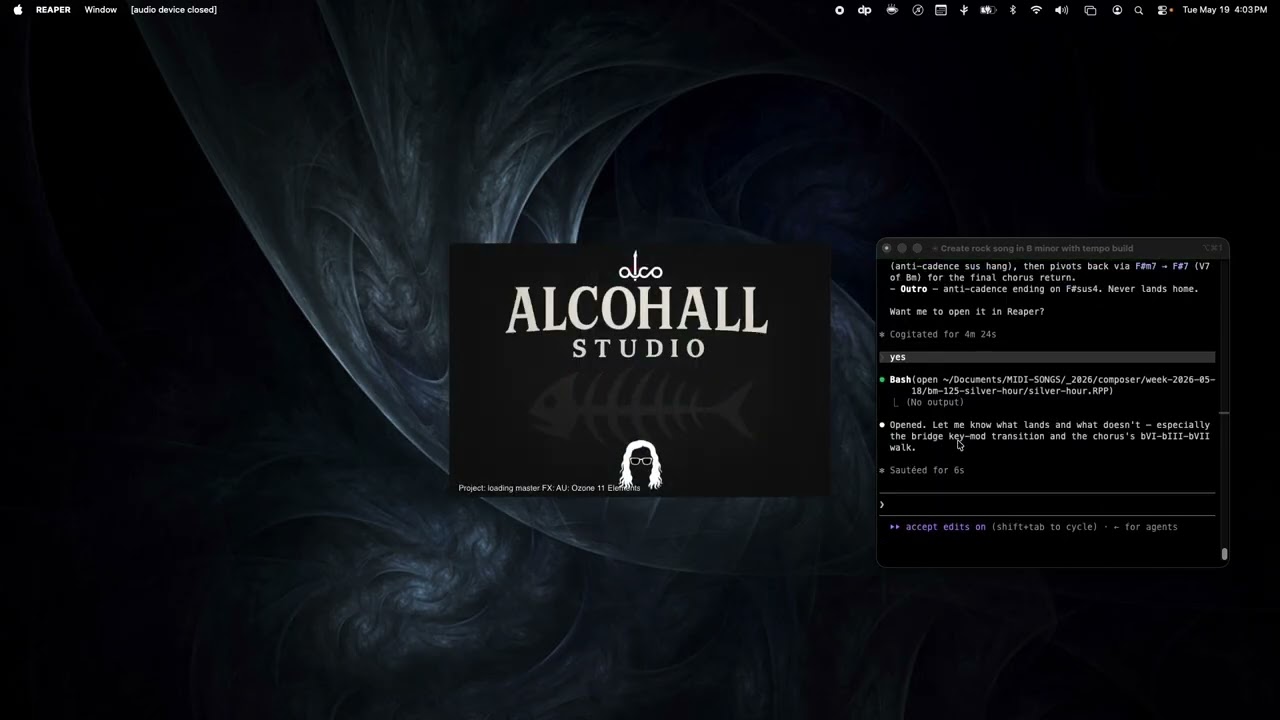
The project is on GitHub if you want to experiment with it:
https://github.com/ricardoalcocer/claude-code-composer
The same shift happened to coding — and I wrote about why the craft is gone but the work isn't.
Musicians have to build their own house too — relying on platforms is its own kind of trap.
Another way I've been filling the songwriting gap is a year-long mentorship with Kiko Loureiro.
📬 Enjoyed this article?
Subscribe for the stuff that doesn't make it onto the blog — half-finished ideas, what I'm reading and listening to, behind-the-scenes notes, and the occasional rabbit hole. No spam, just things worth your time.