Streaming Platforms Don't Care About You
What follows is an idea I've been playing with in my head for over 10 years.
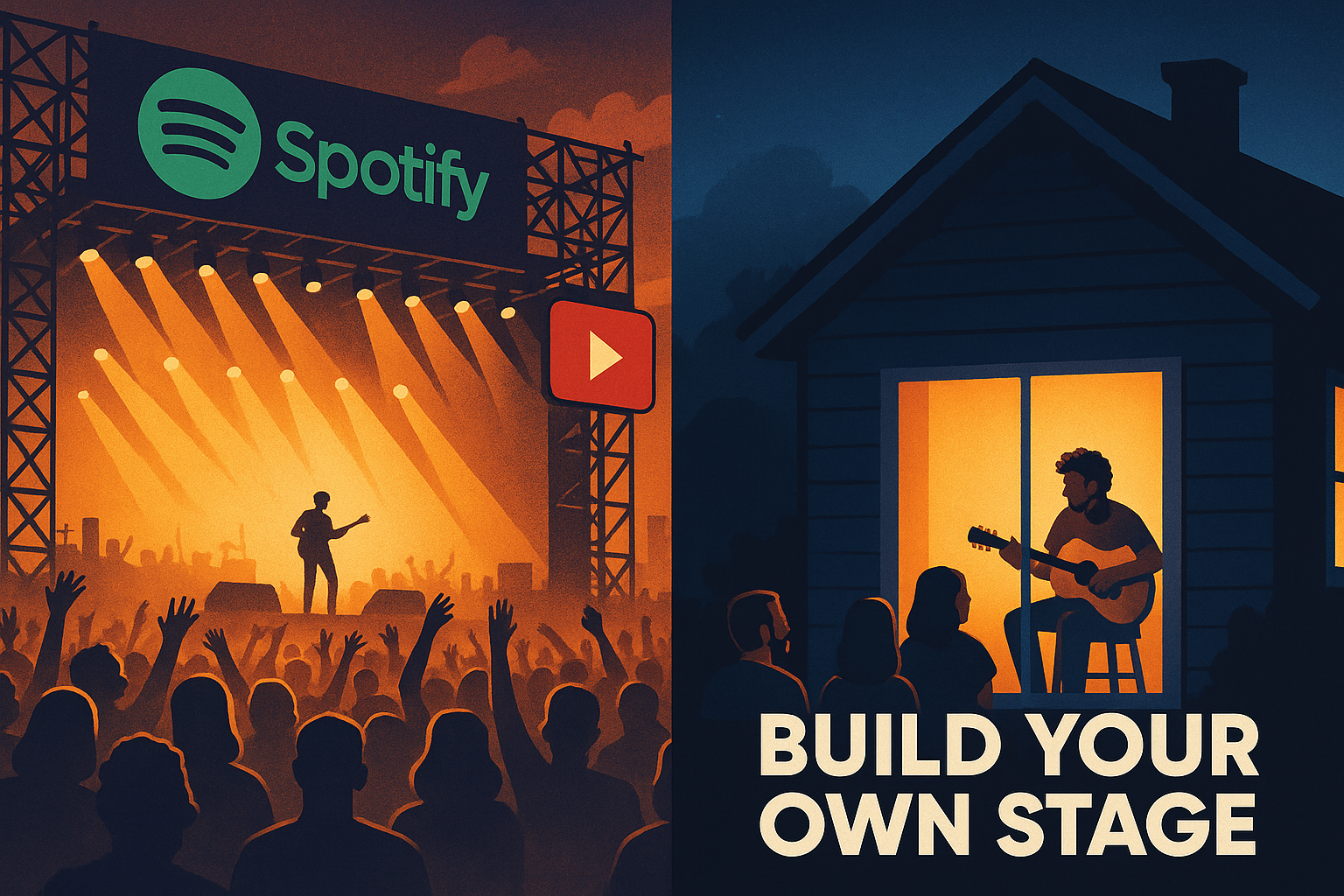
Streaming platforms aren't a home. They're a festival with 10,000 stages playing at once — and the stage manager is an algorithm.
The Festival Illusion
Spotify or YouTube can feel like destinations. In practice, they behave like crowded street markets where attention is rented for moments and then repossessed by the next reshuffle of code.
Visibility is not ownership. A spike is not a relationship. A playlist add is not a fan.
The Algorithm Mirage
The streaming economy rewards output volume, trend-chasing, and "stickiness." Even if you "win," you're still a tenant: your audience lives behind someone else's login, and the landlord can change the locks. Spotify itself explains that it pays through a pro‑rata "streamshare" pool, not a fixed per‑play rate — see Spotify's explainers: Loud & Clear and Understanding Spotify royalties.
Spotify has also added new monetization thresholds and fraud controls: Modernizing our royalty system and Track monetization eligibility. These changes reflect how fragile and conditional "success" on the platforms really is.
The Trust Problem (Platforms Aren't Neutral)
Platforms don't just host art; they embody incentives and values that can collide with yours.
Ethos conflict. In June 2025, Daniel Ek's firm Prima Materia led a €600m round into defense‑AI company Helsing, and Ek serves as Helsing's chairman. Reporting and releases: Financial Times, Reuters, and Tech.eu coverage. Artist reactions include catalog removals and public statements: King Gizzard & the Lizard Wizard, Deerhoof, and LA Times summary.
Fraud and impersonation. Indie artists get caught in the crossfire of botting crackdowns and identity fakery. Useful overviews: The Guardian on bot farms, AI band "Velvet Sundown", and TechRadar on fake uploads.
If a platform can penalize you for someone else's actions, you're not a participant — you're collateral.
Feeding the Beast
Every stream, follower, and upload is platform fuel. The more we feed them, the more they accumulate influence no single artist can counter. These systems don't just curate taste — they gatekeep identity and metadata. If the platform says a track is yours, it's yours; if not, it vanishes.
The Unequal Impact
This chaos rarely touches megastars. Artists at the Bad Bunny tier have labels, lawyers, distribution leverage, and direct lines to platform teams. Problems get fixed with one call. For independents, the same systems become hostile terrain — tickets, forms, and silence.
Guard Your Catalog (Top‑of‑Funnel)
Don't upload your entire catalog to platforms. That's like hanging every painting you've ever made at a street fair. Use platforms as top‑of‑funnel: put the door‑openers (singles, hooks). Reserve deeper cuts — live versions, demos, rarities, extended editions — for your house (your site, Bandcamp, Patreon, newsletter). Build gravity so curiosity turns into relationship.
Social Is the Billboard, Not the Stage
Use social to earn curiosity, then steer people into your world: your website, newsletter, store, calendar, community. A billboard can move a crowd. A house can hold them.
A Small Artist's Bill of Rights
- Own the list. Email is your #1 metric.
- Publish at your address. Fast site; obvious "listen / watch / buy" flow.
- Sell direct first. Then syndicate to streaming.
- Document your catalog. Public page with ISRCs, credits, artwork.
- Harden identity. Trademarking strengthens online enforcement; start with USPTO guidance.
- Choose friction on purpose. Prefer distributors with collaborator confirmations, verified artist IDs, and human review on disputes.
- Avoid playlist‑promo "guarantees." They can get you flagged or banned; see Spotify's policy and CD Baby guidance.
- Audit weekly. New "collabs," odd region spikes, mystery playlists.
- Keep a takedown kit. Screenshots, ISRCs, identity docs, trademark reg, distributor contact, boilerplate emails.
The Festival vs. The House
A festival is thrilling, chaotic, and temporary. A house is smaller but compounding: every visit adds a chair, a lamp, a story. Over time, the house wins.
This isn't anti‑platform; it's anti‑dependency. Use platforms to invite fans home.
Use billboards to point to the porch. Build a space where your music doesn't vanish because an algorithm hiccuped, a policy shifted, or a stranger clicked the wrong box.
The Hard Truth
And I know you won't do this. You're an artist, not a business owner. But here's the thing: you are. Every decision you make about where your music lives, how people discover it, and how you protect it is business.
That doesn't mean you need to run spreadsheets at 2 a.m. or become your own lawyer. It means recognizing that sovereignty is part of the art.
And if that feels impossible, then bring someone into your corner. A friend. A partner. A fan who believes in what you're building. Someone who can help you run the house while you keep making the music.
Because if you don't, the festival will. And it doesn't care about your songs the way you do.
I made the same case about my own data when Pocket announced its shutdown.
This is the impulse that pulled me into building a free-tech school in Puerto Rico years ago.
Most musicians I know flinch at the "you are a business" line. I wrote a whole piece on why they shouldn't.
📬 Enjoyed this article?
Subscribe for the stuff that doesn't make it onto the blog — half-finished ideas, what I'm reading and listening to, behind-the-scenes notes, and the occasional rabbit hole. No spam, just things worth your time.