INTELICA - Instituto de Tecnologías Libres del Caribe
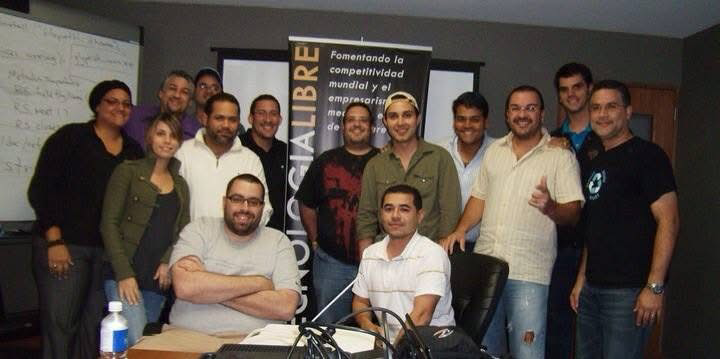 First INTELICA group
In 2010, I was completely immersed in free and open source software. I had published Economía y Productividad con Software Libre and had gradually transitioned from Windows development to exclusively using open source tools. I switched Windows for Linux Mint, and my entire development environment now revolved around the LAMP stack (Linux, Apache, MySQL, PHP).
But I hit a wall when I wanted to hire developers.
In Puerto Rico, tech education at that time was almost entirely focused on the Microsoft ecosystem: Internet Explorer, .NET, Visual Studio, etc. (and maybe in 2025 it's still the same). It wasn't hard to find skilled developers in countries like Chile or Argentina, but something didn't add up. Why didn't Puerto Rican developers see what I saw? Why did they keep drinking the Kool-Aid without questioning where the industry was heading?
I never found a clear answer, but I suspect it has to do with mindset: being trained to focus on the immediate or on what local companies ask for, instead of stepping back and seeing the big picture. And while that's understandable, for me it wasn't enough.
So I decided: if I couldn't hire local developers, I was going to train them myself.
⸻
Teaching Myself to Teach
I managed to strike a deal with a local technical university to offer a course on HTML, CSS, JavaScript, and PHP. I don't remember the economic details, but it felt official: I had an institution backing me, providing the space and promoting the program. That gave it a lot of credibility.
At that time, the war between iPhone and Android was in full swing. I had already moved away from the Microsoft world and was deep into cross-platform development. With the mobile landscape split in two, for me it was crystal clear: the only sensible path was cross-platform development.
That's when I discovered Titanium, a tool created by a company called Appcelerator.
⸻
INTELICA is Born
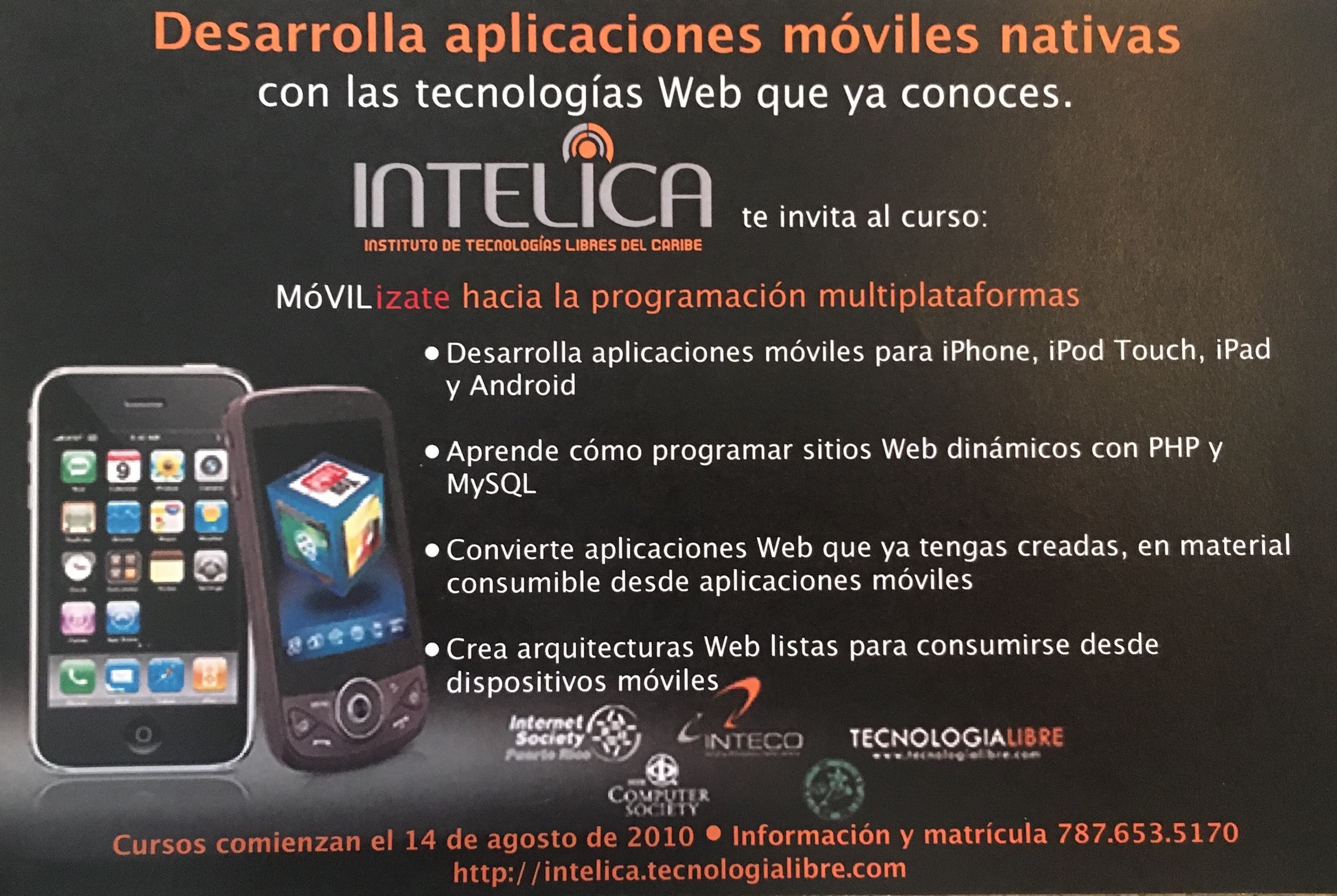 INTELICA advertisement
Later that same year, I started talking with local organizations in Puerto Rico, and one in particular—INTECO—believed in my vision. They became my partners to launch a project I called INTELICA (Instituto de Tecnologías Libres del Caribe). They gave me incredible support, even when my ideas were "a bit crazy."
I traveled to San Jose, California, to attend training with Appcelerator—not so much for the content, but to create a relationship and get access to training materials. But I arrived early: they didn't have a formal training program yet.
That meant I would have to write the course myself.
And meanwhile, INTECO had already confirmed the first group of students.
⸻
The Course
The idea was to cover 40 hours of content across 5 Saturdays—an enormous amount of material in a short time.
I didn't know how to write a curriculum. I didn't know how long it would take me to explain each concept. I didn't have exercises prepared. But I dove in.
Confession: by the time the first class started, I only had that day's content ready. Each week I had six days to prepare the next session.
The content was ambitious for the time: • HTML • CSS • Basic JavaScript • PHP and MySQL • RESTful endpoints • Titanium (for cross-platform mobile apps)
By the end of the course, students had built a complete system: a web app for student registration with login and CRUD operations, and a native mobile app (iOS and Android) that accessed the same backend via API. A full development cycle, across devices and platforms.
Even today, it seems like a solid introduction to that mindset.
⸻
The Technical Challenge
The lab wasn't mine—I had no control over the machines. Each week, students could end up on a different computer.
To solve this, I worked with my dad to create a custom Linux distribution with everything pre-installed. It ran from an 8GB USB stick.
On the first day of the course, I handed them out. Students could buy them for $20 or return them at the end of the course. Those who kept it had a complete development environment in their pocket—ready to boot from anywhere: home, school, library, whatever.
⸻
Growth and Traction
INTECO handled the promotion, and the Puerto Rico College of Engineers and Surveyors accredited the course as continuing education hours.
I offered the full 40-hour course for about a year, and then created an intensive Titanium-only version—10 hours on a single Saturday. For that course, I had a dedicated room and people brought their laptops. I brought coffee, water, and pizza. It felt like a real hackathon.
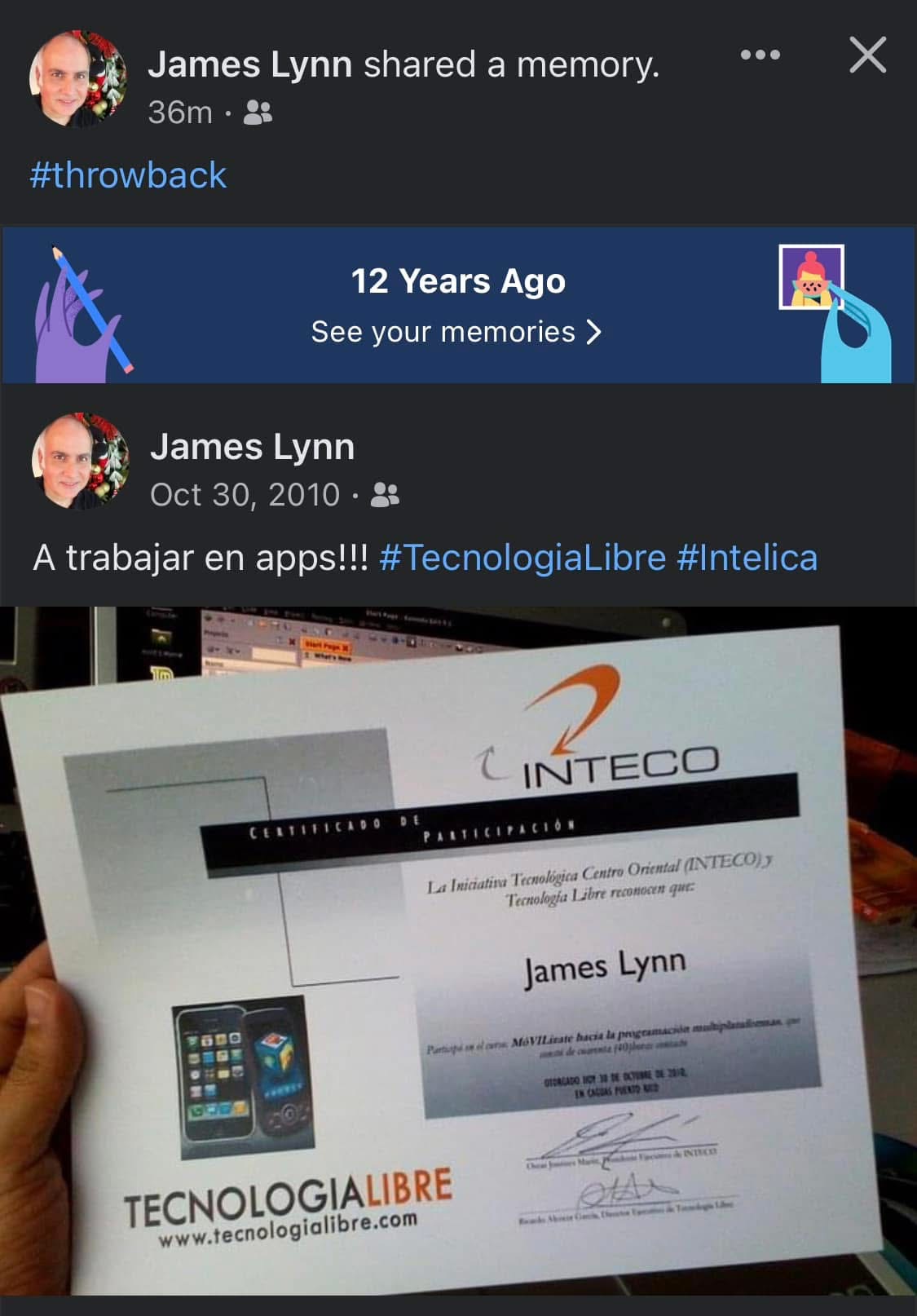 James Lynn showing his INTELICA certificate in a throwback
By the end of 2011, I was already thinking about the next step. I lost interest in the project, stopped promoting the course, and let it die peacefully.
But by then, I was something of a Titanium expert. I had taught about 150 people—a number that, at the time, seemed huge to me. And I had a story to tell.
⸻
The Next Chapter
In July 2012, I moved from San Juan, PR to Sunnyvale, California. I walked 15 minutes every morning to Appcelerator's offices in Mountain View.
They had hired me to do developer relations in Silicon Valley—something I had never done before and knew little about. But I took it seriously. I soon went from being a Platform Evangelist to Principal Evangelist, and eventually to Director of Developer Relations and Training.
Remember that in 2010 Appcelerator didn't have a training program to offer me? Well, now I was leading the team that built it. Full circle.
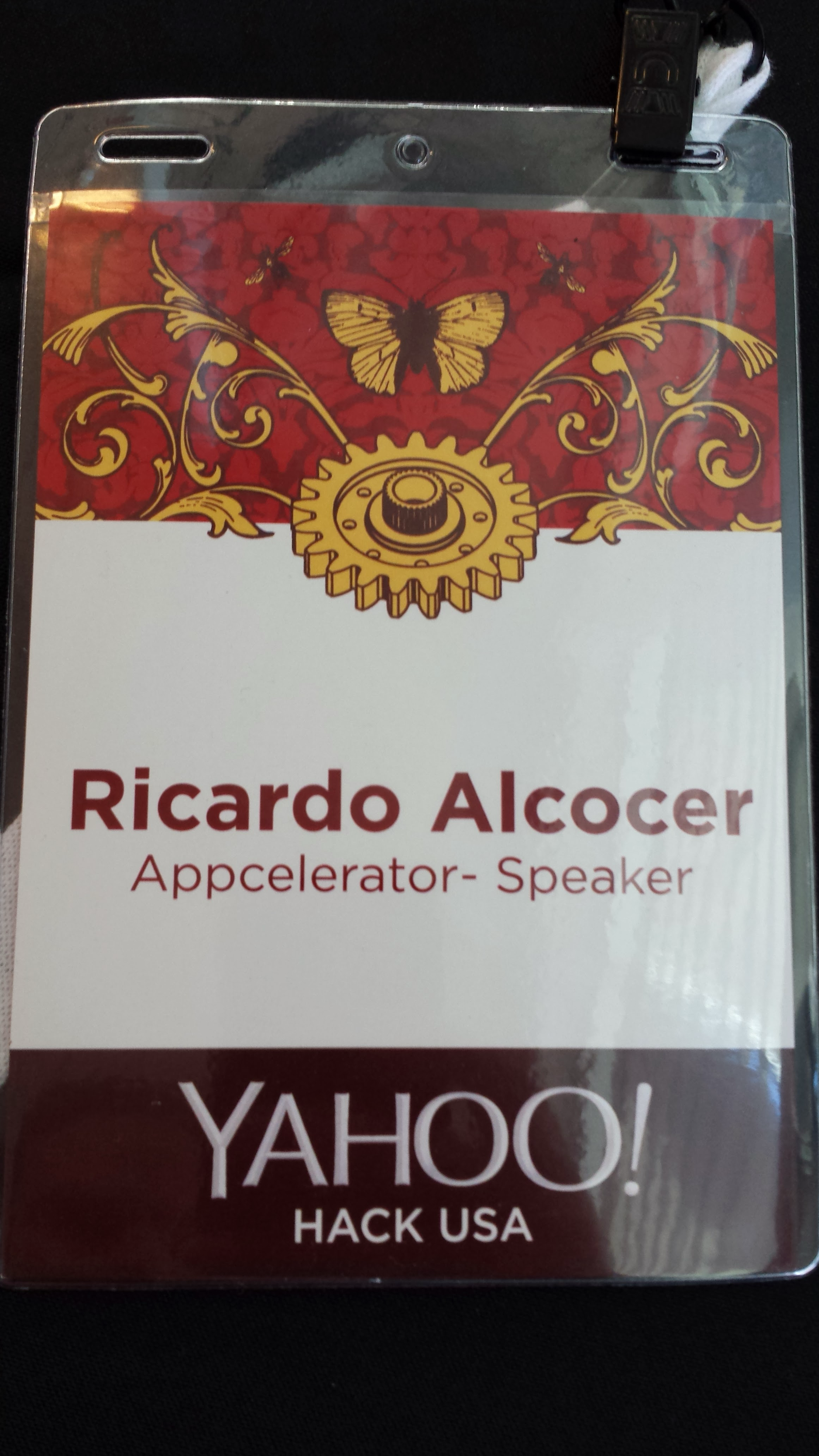 My badge when I spoke at Yahoo!
I led all global developer-facing initiatives at the company. By the time I left, the developer community had grown to almost 900,000 people.
I also wrote what could be considered the most important book on Appcelerator—though of course, it's easy for me to say that. I thoroughly enjoyed working on that book. More on that in another post.
⸻
Looking Back
Today everything seems to have flowed naturally, almost inevitably.
But it wasn't.
It was chaotic, stressful, and full of uncertainty. I left behind the company I had built for over eleven years, along with my local connections, my comfort zone, my family, and my son (from my first marriage).
But the future was bright—and it was calling me.
I ended up living in the San Francisco Bay Area until late 2018, when I moved to Mexico City.
It's incredible to think that this whole journey began simply because I was frustrated with how technology was taught in Puerto Rico.
The Titanium book I wrote years later came directly out of this same Appcelerator chapter.
Around the same years, I was also talking tech on Puerto Rican television.
This was the prelude — three years later I was in Tokyo giving a talk for Appcelerator.
📬 Enjoyed this article?
Subscribe for the stuff that doesn't make it onto the blog — half-finished ideas, what I'm reading and listening to, behind-the-scenes notes, and the occasional rabbit hole. No spam, just things worth your time.