The Relationship With Our Creations
The other day I received a notification that someone had downloaded a copy of my book Economía y productividad con software libre.
That book was published in 2009.
Seventeen years ago.
The notification felt surreal, almost accidental, like finding footprints in a room you haven't entered in decades.
I don't know who downloaded it. I don't know why. I don't know if they'll read five pages or the entire thing.
But for a brief moment, something I made a long time ago became alive again.
And it made me think about the strange relationship we have with the things we create.
When we release something into the world, we tend to imagine a very immediate timeline: launch day, reactions, reviews, sales, comments, applause.
We measure success by impact occurring near the moment of creation.
But that's not always how creative work behaves.
Sometimes the real life of a creation starts years later.
A forgotten PDF. An old GitHub repository. A song someone discovers at 2AM. A blog post indexed by Google. A forum reply from 2003 that still solves someone's problem.
The internet is strange that way.
On the surface, everything feels disposable. Infinite feeds. Infinite scrolling. Posts evaporating in hours.
And yet underneath all that noise, the internet also remembers.
Quietly.
Somewhere, a server still hosts a file you uploaded fifteen years ago. A stranger finds it through a search query. Something you made begins moving through another person's mind.
Without you even knowing.
Social media trained us to think of creativity as performance. As immediacy. As engagement metrics.
But books, essays, software, music, and ideas often operate on completely different timescales.
Geological timescales.
I've written books that never became bestsellers. Built projects that never went viral. Published posts that barely received reactions.
And honestly, that's okay.
I never wrote because I expected mass attention. I wrote because I wanted the thing to exist.
That's still true today.
Sometimes I think creators misunderstand the nature of what they're building.
We think we are creating moments.
But maybe we are really creating artifacts.
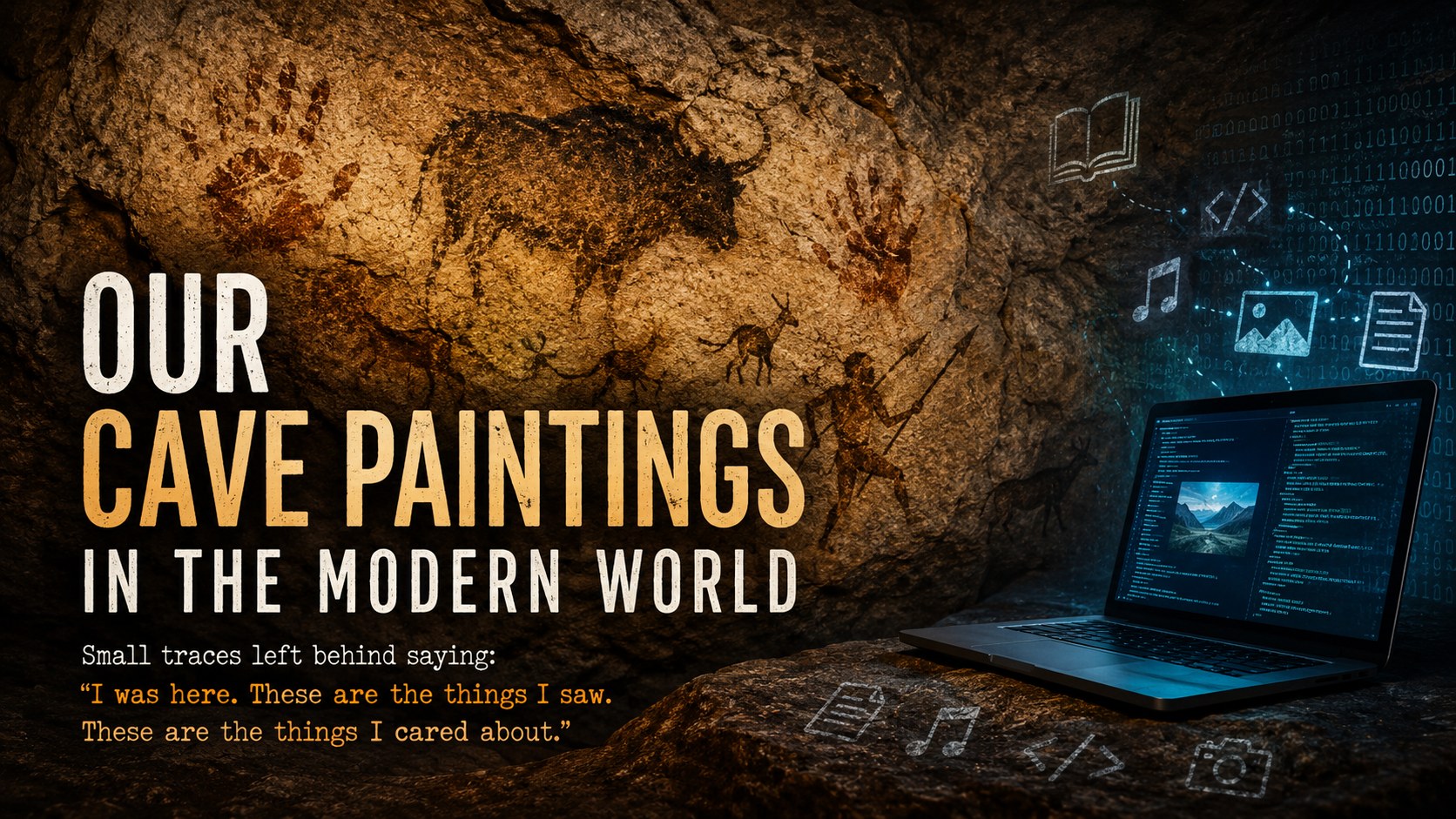
Small signals left behind saying:
"I was here." "These are the things I cared about." "This is how the world looked through my eyes."
These are our cave paintings in the modern world.
Small traces left behind saying:
"I was here. These are the things I saw. These are the things I cared about."
And the strange thing is that we rarely get to choose which creations survive.
Not the ones we worked hardest on. Not necessarily the ones that made the most money. Not the ones with the most likes.
Sometimes it's the obscure article. The tiny utility. The old open-source book. The unfinished song.
The thing that simply continued to exist long enough to find another human being years later.
Maybe that's enough.
Maybe that was always the point.
I wrote elsewhere about what actually outlasts paper and silicon — and it isn't either of them.
Bonampak's murals are still here a thousand years later. Modern cave paintings, but slower.
Another book of mine still sells a copy or two every few years — and that turns out to be enough.
📬 Enjoyed this article?
Subscribe for the stuff that doesn't make it onto the blog — half-finished ideas, what I'm reading and listening to, behind-the-scenes notes, and the occasional rabbit hole. No spam, just things worth your time.