When the Problem Is Gone
In software, there's a joke:
"We have a solution. Now we need a problem."
It usually means we built something clever before fully understanding what it was for. Archaeology often works in reverse: it finds the solution first — stone structures, carved chambers, modular blocks, drainage systems — and has to guess the problem.
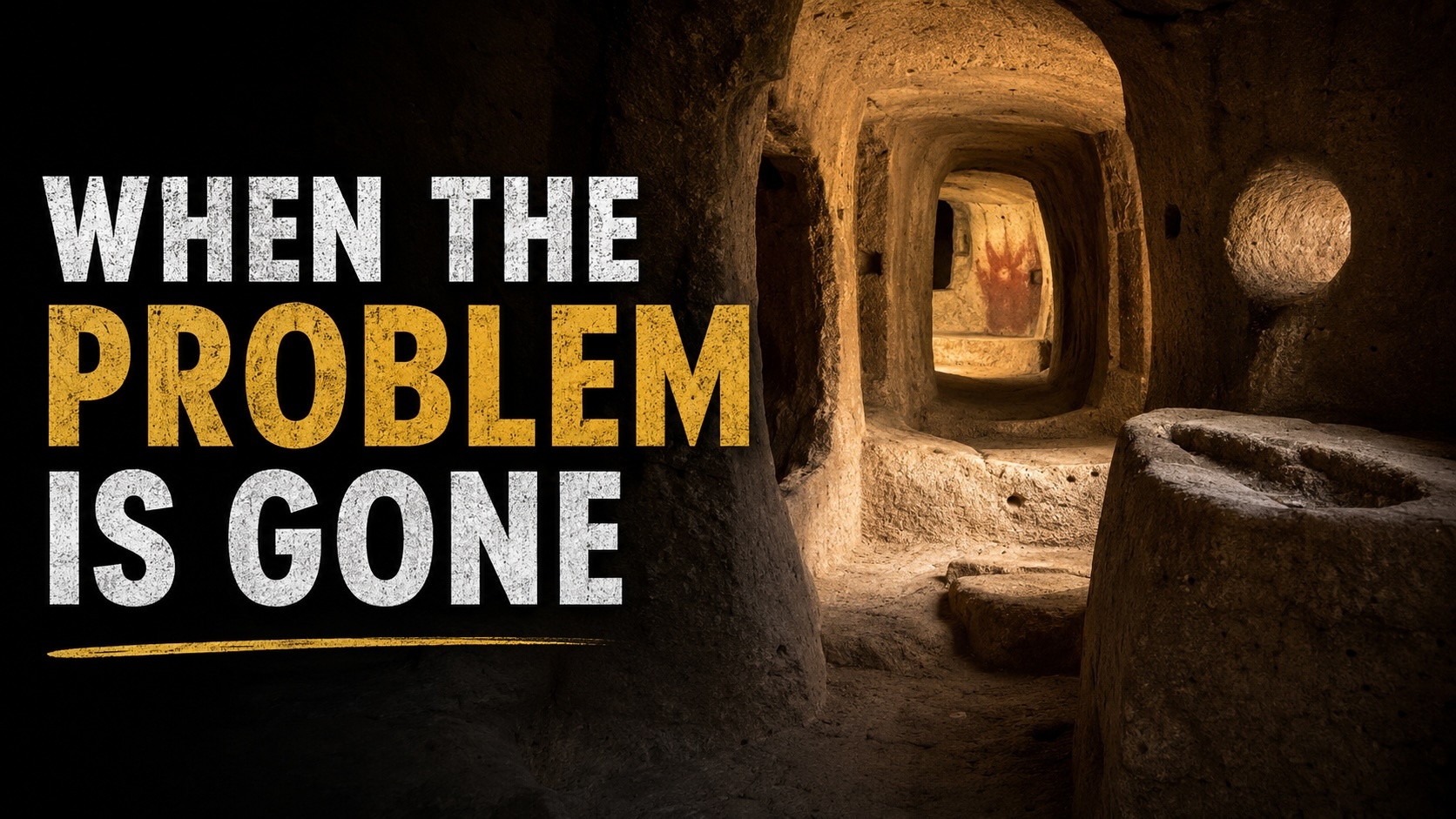
Two days after walking through the Hal Saflieni Hypogeum in Malta, I'm still thinking about this. The Hypogeum is an underground prehistoric structure carved into limestone around 4000 BCE: chambers, niches, strange acoustics, red ochre markings. The accepted explanation leans toward burial and ritual, and that may well be right. But it exposes a pattern — when we don't know what something was for, we often call it ritual. Archaeologists aren't being careless. It's that function without explanation tends to decay into symbolism.
Take Gobekli Tepe, where massive carved pillars arranged in circles are covered in animals: the dominant interpretation is ceremonial. Or Pumapunku, where the famous H-blocks show astonishing precision and modularity, usually labeled monumental architecture. Or Mohenjo-daro, where urban planning and advanced drainage survived but the script remains unread. In every case we have pieces of the solution but not the original problem. That's the part that vanished first.
Technology is downstream from necessity. A fishing net only makes sense if you know what an ocean is, that fish exist in it, and that someone needed to catch them. Remove that context and a future archaeologist might call it decorative weaving.
Wrong object. Wrong function. Wrong story.
The same applies at civilizational scale. The Maya understood the wheel — we know because wheeled toys have been found, which is the important detail: they had the concept. They simply never built wheel-based transportation the way Eurasia did, and not for lack of intelligence. They lacked the problem-space that made the wheel indispensable elsewhere: no horses, no oxen, dense jungle, mountainous terrain, and human porter systems already in place.
The wheel existed. The necessity didn't.
That breaks a common assumption — that invention naturally leads to adoption. It doesn't. Technology only scales when it fits the world that needs it.
We know ancient humans were anatomically and cognitively like us: same brains, same capacity for abstraction, pattern recognition, and experimentation. What they didn't have was our inherited stack of accumulated knowledge, which doesn't make them lesser so much as it makes their problem-space different. A Bronze Age engineer understood materials, seasons, structural loads, water systems, and ecological patterns through direct contact with the environment. That knowledge wasn't theoretical. It was lived.
And if their needs were different from ours, their technologies would be too. I'd never invent a fishing net if I had never seen an ocean, never seen a fish, and never needed one to survive.
That's the trap. Without knowing what ancient people actually needed — what pressures shaped them, what constraints they lived under, what problems defined their world — we can't reliably reconstruct backward what something we find was for. And we may never know. What survives are rocks, sites, pottery, fragments. But surviving is not the same as explaining.
We don't know what many of these things were used for. The stories died, and the context died with them. Without a living reference point, function becomes inference, inference becomes theory, and theory, over enough time, hardens into history.
Imagine a civilization five thousand years from now uncovering CERN. A giant underground ring. Restricted chambers. Specialized priesthood. Strange symbols. Energy directed toward invisible things. Without the math, without the physics, without the problem it was solving, how long before they call it a temple?
Maybe some of what we call religion was religion. But maybe some of it was engineering whose problem no longer exists.
Or worse —
whose world we no longer recognize.
If rocks are what outlast us, the question of what we should carve into them matters more than it sounds.
The same instinct that turns fragments into stories is the one I spent a career using on dashboards — finding stories inside noisy systems, and learning how often they aren't there.
Sometimes the context does survive: at Yaxchilán, carved lintels still name the people in them and say what they were doing.
📬 Enjoyed this article?
Subscribe for the stuff that doesn't make it onto the blog — half-finished ideas, what I'm reading and listening to, behind-the-scenes notes, and the occasional rabbit hole. No spam, just things worth your time.