From Analytics to Archaeology
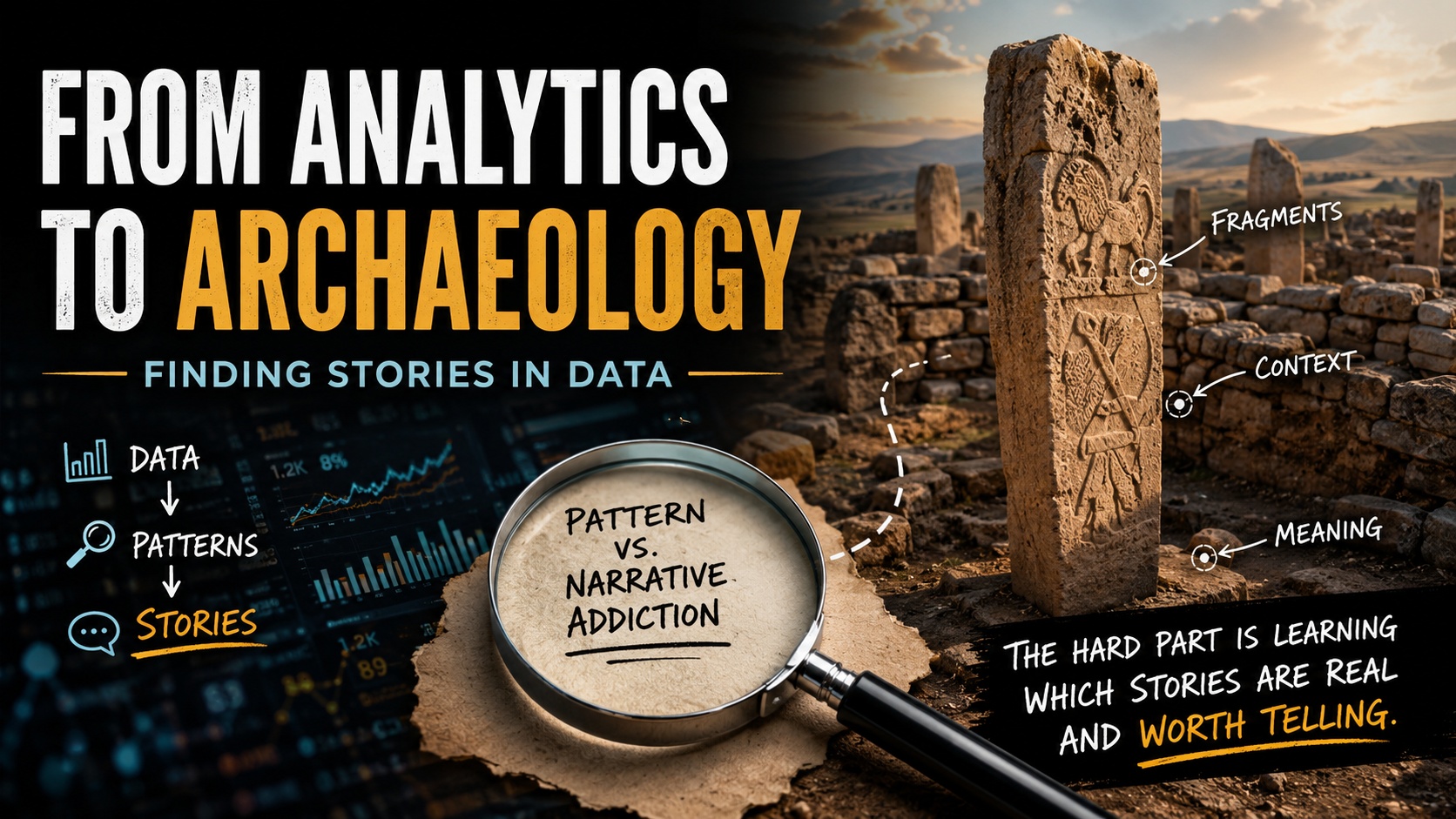
Or: finding stories in data.
One of the most useful skills I accidentally developed during my years in technology had very little to do with programming.
It was learning how to detect stories hidden inside noisy systems.
At the time, I didn't think of it that way. Back then we called it analytics, developer relations, community engagement, product feedback, growth, metrics. In practice the work was much more human than technical. You would stare at dashboards, forum posts, conference reactions, support tickets, adoption curves, and scattered conversations across the internet, trying to answer questions that never appeared directly in the data. Why are developers abandoning this feature? Why did this presentation resonate in Japan but not in Germany? Why are people excited about something the company itself barely noticed?
The numbers themselves were rarely the story. The story lived in the pattern behind the numbers.
Over time I realized the same process appears almost everywhere. Archaeologists do it with broken pottery and bones, detectives with fragments of evidence, doctors with symptoms, musicians with motifs and rhythm, magicians with attention and behavior, historians with incomplete records.
Human beings are pattern-detection machines. We constantly try to transform chaos into narrative.
Sometimes this ability is extraordinary — it gives us science, medicine, engineering, language, and civilization itself. But it has a dangerous side: we're so good at finding patterns that we often find stories that don't actually exist. That's where conspiracy theories are born, along with superstition, financial bubbles, cults, internet outrage cycles, and probably half the nonsense currently surrounding artificial intelligence.
The same brain that allows someone to discover hidden structure inside complex systems can also convince them that randomness contains secret meaning.
That tension fascinates me, because I now realize many of my interests are actually the same interest wearing different costumes. When I read about ancient civilizations, I'm looking for signal inside incomplete evidence. When I write music, I'm searching for emotional patterns that feel coherent. Studying skepticism is my attempt to separate observation from narrative addiction, and writing blog posts is usually the exact same move — finding the larger human pattern hidden inside a specific story.
Even my own career looks different through this lens. At the time I thought I was learning web development, public speaking, marketing, startups, community building. Maybe the deeper skill underneath all of it was learning how to interpret systems made of people.
And honestly, that may explain why certain topics feel endlessly interesting to me. Technology, archaeology, psychology, music, history, human behavior — they all generate data, and somewhere inside that noise there's always a story trying to emerge.
The hard part is learning which stories are real…
and which ones are worth telling.
The pattern-detection machine has a spokesperson too — I wrote about how the brain has a press secretary that invents reasons after the fact.
I once watched the gap-filling side of this fail in real time, with nothing more than a cardboard box moving on its own.
And the oldest tool I own for separating observation from narrative is a 500-year-old lie detector — the first skeptical book ever written about magic.
📬 Enjoyed this article?
Subscribe for the stuff that doesn't make it onto the blog — half-finished ideas, what I'm reading and listening to, behind-the-scenes notes, and the occasional rabbit hole. No spam, just things worth your time.