The Brain Has a Press Secretary
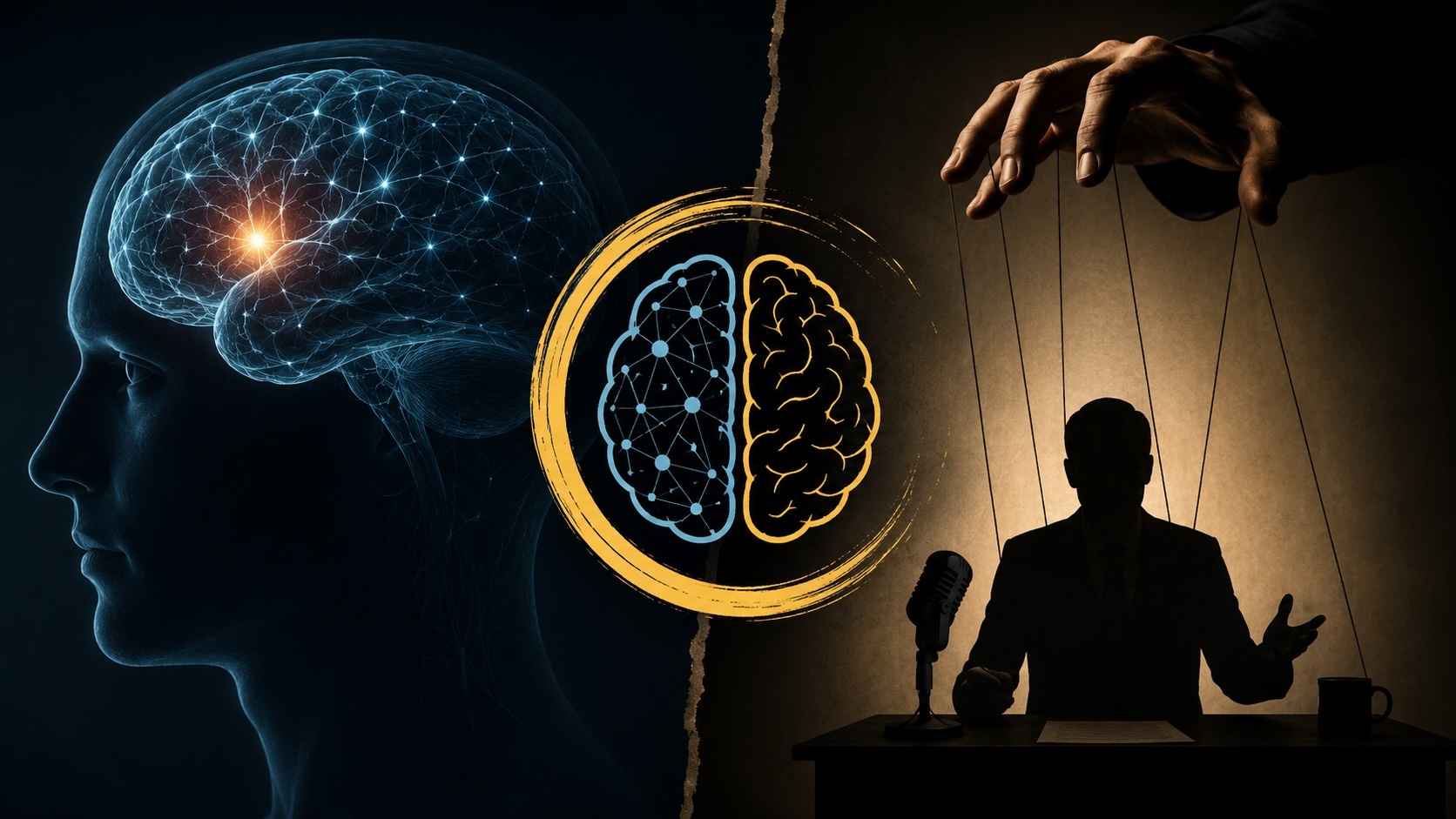
A roboticist, a neuroscientist, and a magician walk into the same problem.
That sounds like the beginning of a joke.
Instead, it may be the beginning of an uncomfortable truth.
A few days ago, two unrelated videos appeared in my feed within hours of each other.
One was about a guy building a $100 robot using neural networks, reinforcement learning, and large language models.
The other was about split-brain experiments, free will, and the unsettling possibility that many of our decisions are made before we become aware of them.
At first, they seemed unrelated.
One was about artificial intelligence.
The other was about human consciousness.
But the deeper I went, the more I realized they were circling the same question.
Not whether machines can think.
But whether humans actually understand how they think.
That question matters to me for reasons beyond science.
I've been performing magic since 1988, long before I knew words like confabulation, predictive processing, or post-hoc rationalization.
What I did know was this:
spectators are often unreliable witnesses to their own experience.
Darwin Ortiz writes in Strong Magic that audiences remember effects, not methods.
That sounds obvious until you've watched it happen.
I've seen spectators confidently describe sequences of events that objectively never happened.
They remember cards being placed where they weren't.
They insist I never touched the deck when I clearly did.
They describe choices as freely made when they were heavily influenced.
Their certainty is real.
That certainty has fascinated me for decades.
Modern neuroscience suggests it might explain far more than magic.
In the 1960s, neuroscientist Michael Gazzaniga began studying split-brain patients after surgeons severed the corpus callosum, the bridge connecting the brain's two hemispheres.
One of his most famous experiments remains deeply unsettling.
A patient was shown a chicken claw to one hemisphere and a snowy scene to the other.
Asked to point to related images, one hand selected a chicken and the other a shovel.
When asked why, the speaking hemisphere explained:
"The chicken claw goes with the chicken, and you need a shovel to clean out the chicken shed."
There was just one problem.
That explanation was impossible.
The speaking hemisphere had never seen the snowy scene.
It simply invented a plausible story.
Gazzaniga called this mechanism the interpreter — the part of the brain that constantly builds narratives to explain behavior, even when it lacks the information to do so.
That idea alone should make us uncomfortable.
Because it suggests the brain would rather fabricate coherence than admit ignorance.
Years later, Benjamin Libet found that the brain begins preparing for movement before a person becomes consciously aware of deciding.
He called this the readiness potential.
Later, John-Dylan Haynes pushed this further, detecting measurable patterns in the brain up to seven seconds before subjects reported making a choice.
Seven seconds.
That's not a delay.
That's a head start.
Robert Sapolsky takes this much further in Determined.
His argument isn't really about milliseconds.
It's about causality.
Every behavior is shaped by what came before it.
Genes.
Hormones.
Childhood.
Stress.
Sleep.
Culture.
Context.
By the time a conscious choice appears to us, it has already been shaped by forces we barely notice.
The decision may feel immediate.
Its causes often began decades earlier.
This doesn't necessarily prove free will is an illusion.
Even Libet himself argued for a kind of veto — what some call free won't.
But it raises a harder question:
How much of our conscious life is explanation rather than authorship?
That question took an unexpected turn when I watched the robotics experiment.
The creator built a tiny robot and gave it a body, memory, and language.
But he quickly ran into a problem.
Reasoning was too slow.
For the robot to move fluidly, it needed prediction first.
A fast internal model of the world.
Only afterward could slower reasoning participate.
Fast prediction.
Action.
Correction.
Slow interpretation.
That architecture felt strangely familiar.
Daniel Kahneman divided cognition into System 1 and System 2.
Fast and slow.
Automatic and deliberate.
The robot looked like a physical version of that distinction.
It sounded less like a machine.
And more like us.
As a guitarist, this part felt immediately familiar.
You can study scales, phrasing, and harmony for years, but when improvising, there's no time for conscious thought.
The fingers often move before language arrives.
The decision feels immediate.
But the machinery behind it has been training for decades.
That isn't theory.
That's lived experience.
The same thing happens in sleight of hand.
A pass.
A palm.
A false transfer.
At speed, these aren't conscious checklists anymore.
They become embodied prediction.
The body acts.
The conscious mind catches up.
That same pattern appears in mentalism.
Ian Rowland's The Full Facts Book of Cold Reading lays this out with unsettling clarity.
Cold reading — the same family of techniques used in tarot readings, psychic sessions, profiling, and interrogation — doesn't work because someone is accessing hidden truths.
It works because the subject actively helps construct the outcome.
A vague statement is offered.
The participant searches memory.
Finds a connection.
Supplies the missing meaning.
And afterward remembers it as if it had been precise all along.
The performer plants the seed.
The participant grows the tree.
Joshua Jay writes in How Magicians Think that deception in magic is less about hiding reality than shaping attention.
And attention shapes memory.
Memory shapes narrative.
Narrative shapes belief.
That mechanism feels deeply familiar.
It feels like Gazzaniga's interpreter.
It feels like Sapolsky's post-hoc reasoning.
It feels like what magicians have exploited for centuries.
And it may even resemble what AI researchers now call world models.
After more than thirty years working in software, I've spent much of my life thinking in systems, inputs, and outputs.
What fascinates me about modern AI isn't that it thinks like us.
It's that trying to build it keeps revealing how much of our own cognition was invisible to us.
Neuroscientists studying consciousness.
Magicians studying deception.
Mentalists studying belief.
Roboticists studying intelligence.
All of them seem to be converging on the same observation:
Human beings are not passive observers of reality.
We are active authors of our interpretation of it.
Jonathan Haidt once described the conscious mind not as the Oval Office, but as the press office.
Not the decision-maker.
The spokesperson.
The storyteller.
I'm not prepared to say free will doesn't exist.
That debate is older and more complicated than any one article can settle.
But I am increasingly convinced of something else.
Much of what we think we know about why we do what we do may have been assembled after the fact.
Not as lies.
But as stories.
And perhaps that is the strangest possibility of all.
That consciousness may be less like a CEO and more like a press secretary.
The action begins.
The decision is made.
And a moment later, the narrator arrives to explain why it was obviously the right thing to do.
⸻
Bibliography & Further Reading
This article was informed by a mix of neuroscience, psychology, robotics, magic theory, and mentalism. If this topic interests you, these are the sources worth exploring.
Neuroscience / Consciousness / Free Will
Sapolsky, Robert M. — Determined: A Science of Life Without Free Will
Gazzaniga, Michael S. — The Mind's Past
Libet, Benjamin — Mind Time: The Temporal Factor in Consciousness
Haynes, John-Dylan — Research on predictive brain activity preceding conscious awareness
Haidt, Jonathan — The Happiness Hypothesis
Kahneman, Daniel — Thinking, Fast and Slow
Videos
Sapolsky, Robert — "Neuroscientist: How To Escape The Rat Race" — YouTube interview
Sapolsky, Robert — "Robert Sapolsky on Free Will and Determinism" — YouTube
Sapolsky, Robert — "The Brain, Determinism, and Cultural Implications" — The Great Simplification #88
Sapolsky, Robert — "The Biology of Humans at Our Best and Worst" — YouTube
Sapolsky, Robert — "You Have No Free Will at All" — Stanford professor interview
Sapolsky, Robert — "There's No Free Will. What Now?" — YouTube
Magic Theory / Perception
- Ortiz, Darwin — Strong Magic
- Jay, Joshua — How Magicians Think
Mentalism / Suggestion / Cold Reading
- Rowland, Ian — The Full Facts Book of Cold Reading
- Harling, Ian & Nyrup, Martin — Sleight of Mind: Suggestion and Mind Control
- Pearlman, Oz — Read Your Mind
Robotics / AI
- "I Gave ChatGPT a Body" — GrowBot project, Art of the Problem
- "You Decided To Watch This Video 7 Seconds Ago" — Split-brain and free will
The mind fills in what it never saw, the same way the invisible scales of magic stay hidden beneath a clean effect.
Long before neuroscience had the vocabulary, a 500-year-old book on how we deceive ourselves was already mapping how easily belief gets manufactured.
If the brain narrates its own choices after the fact, no wonder we're so defenseless against AI's synthetic version of reality.
📬 Enjoyed this article?
Subscribe for the stuff that doesn't make it onto the blog — half-finished ideas, what I'm reading and listening to, behind-the-scenes notes, and the occasional rabbit hole. No spam, just things worth your time.