This Is My 42
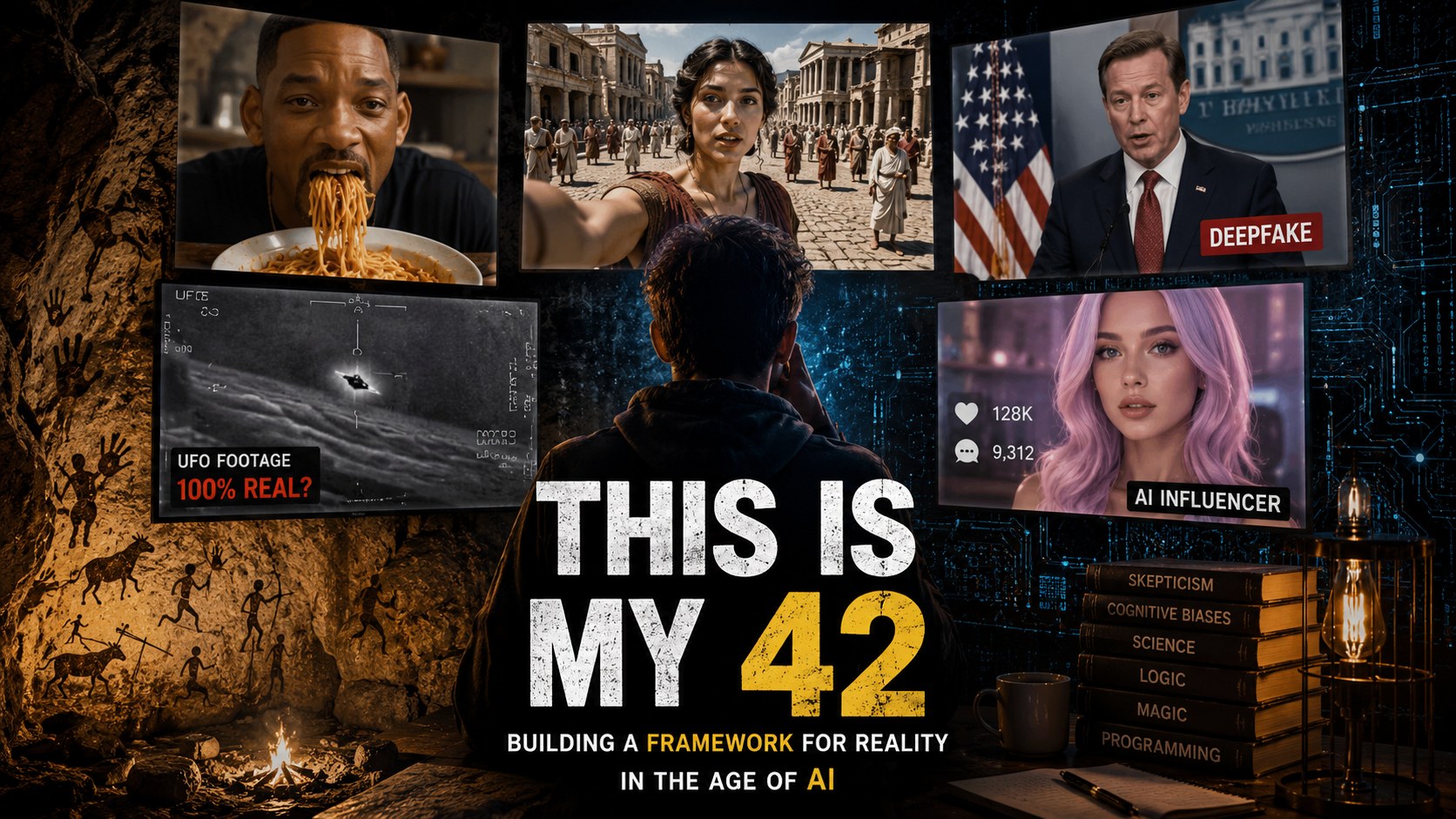
A few weeks ago I discovered Chloe vs History.
The premise is simple: an AI-generated girl travels through history filming selfie-style videos.
Ancient Rome. Pompeii. Historical disasters. Lost civilizations.
And honestly?
I think some of it is incredible.
Not in the "look what AI can do" sense.
I mean genuinely incredible.
For someone fascinated by history, archaeology, ancient civilizations, and the human story, these videos trigger something powerful: they make the past feel emotionally close.
Not like reading a textbook.
More like standing there.
There's something deeply compelling about technology being able to collapse the distance between information and experience.
A kid watching a reconstructed Roman street full of movement, sound, and people may suddenly care about history in a way they never would through static images in a schoolbook.
That's real.
But almost immediately after that feeling comes another one:
Concern.
Because while I can appreciate these videos as creative historical reconstructions, I also know many people increasingly cannot distinguish between:
- reconstruction and documentation,
- simulation and evidence,
- plausibility and truth.
And that realization feels much bigger than AI videos.
It feels civilizational.
For most of human history, seeing something with your own eyes meant something.
A photograph was evidence. A recording was evidence. A video carried weight.
That world is disappearing.
We are entering an era where:
- voices can be cloned,
- faces can be generated,
- interviews can be fabricated,
- historical footage can be synthesized,
- fake experts can be invented,
- and emotional realism can be manufactured at almost zero cost.
The technology itself is not inherently evil.
In many ways, it's astonishing.
But humans are not psychologically prepared for photorealistic fiction at planetary scale.
And maybe that's because we were never psychologically prepared for this world to begin with.
Ella Al-Shamahi often points out that humans are still basically cave people trying to function inside a modern technological civilization.
I think about that a lot.
Because our brains evolved for:
- small tribes,
- direct observation,
- immediate threats,
- oral storytelling,
- emotional decision-making,
- and pattern recognition.
Not:
- infinite information streams,
- algorithmic manipulation,
- synthetic media,
- AI-generated humans,
- statistical reasoning,
- or global outrage machines operating 24 hours a day.
We are still running prehistoric firmware inside a civilization of satellites, algorithms, and synthetic reality.
And this is where I realized I've spent most of my adult life unconsciously building a framework for navigating reality.
Not because I'm immune to manipulation.
Quite the opposite.
Because I know how vulnerable humans are to it.
Part of that came from programming. Systems fail in unexpected ways.
Part came from science and skepticism. Humans are full of cognitive biases.
Part came from magic. Human perception is astonishingly hackable.
A magician can force your attention. A politician can force your emotions. An algorithm can force your outrage. An AI can force your perception.
Same brain. Different exploit.
Over time, I realized I had developed a sort of mental checklist whenever I encounter extraordinary claims, emotionally charged information, or things that seem "obviously true."
Questions like:
- What is the actual evidence?
- Could there be a simpler explanation?
- Am I emotionally invested in this being true?
- Is this an echo chamber?
- Am I confusing confidence with accuracy?
- What would convince me I'm wrong?
- Is this documented reality or reconstructed plausibility?
Eventually I discovered names for many of these traps: confirmation bias, pareidolia, the Barnum effect, motivated reasoning, survivorship bias, burden of proof, falsifiability.
But honestly, the labels matter less than the habit.
The habit of pausing.
The habit of separating:
"I saw it" from "I verified it."
Over time, I realized this wasn't just skepticism.
It was a framework.
A personal operating system for deciding: what deserves belief, what deserves doubt, and what deserves a temporary "I don't know yet."
Because whether we realize it or not, we all build frameworks for interpreting reality.
Some inherit them from religion. Some from politics. Some from family. Some from social media algorithms.
Mine emerged from programming, magic, science, skepticism, and decades watching how easily humans — including myself — can confuse confidence with truth.
And I think this is becoming one of the defining survival skills of modern life.
Maybe previous generations needed literacy.
Ours may need epistemology.
Not in the academic sense.
In the survival sense.
Because in a world of AI-generated realities, algorithmic persuasion, and infinite information streams, the ability to critically evaluate what you're seeing may become as important as reading itself once was.
So yes — this is my framework.
My version of 42.
Not an answer to the universe.
An error-correction system for navigating it.
And honestly, in a world like this, it's amazing more of us don't become Marvin the Paranoid Android.
Reginald Scot built something like this framework 500 years ago with a book about witchcraft — and people still haven't caught up.
The reason perception is so hackable is that the best deception is built on thousands of invisible hours of practice.
The same AI rewriting our sense of reality is also rewriting what it means to code — same shift, different exploit.
📬 Enjoyed this article?
Subscribe for the stuff that doesn't make it onto the blog — half-finished ideas, what I'm reading and listening to, behind-the-scenes notes, and the occasional rabbit hole. No spam, just things worth your time.