Tarxien: What Do We Actually Know?
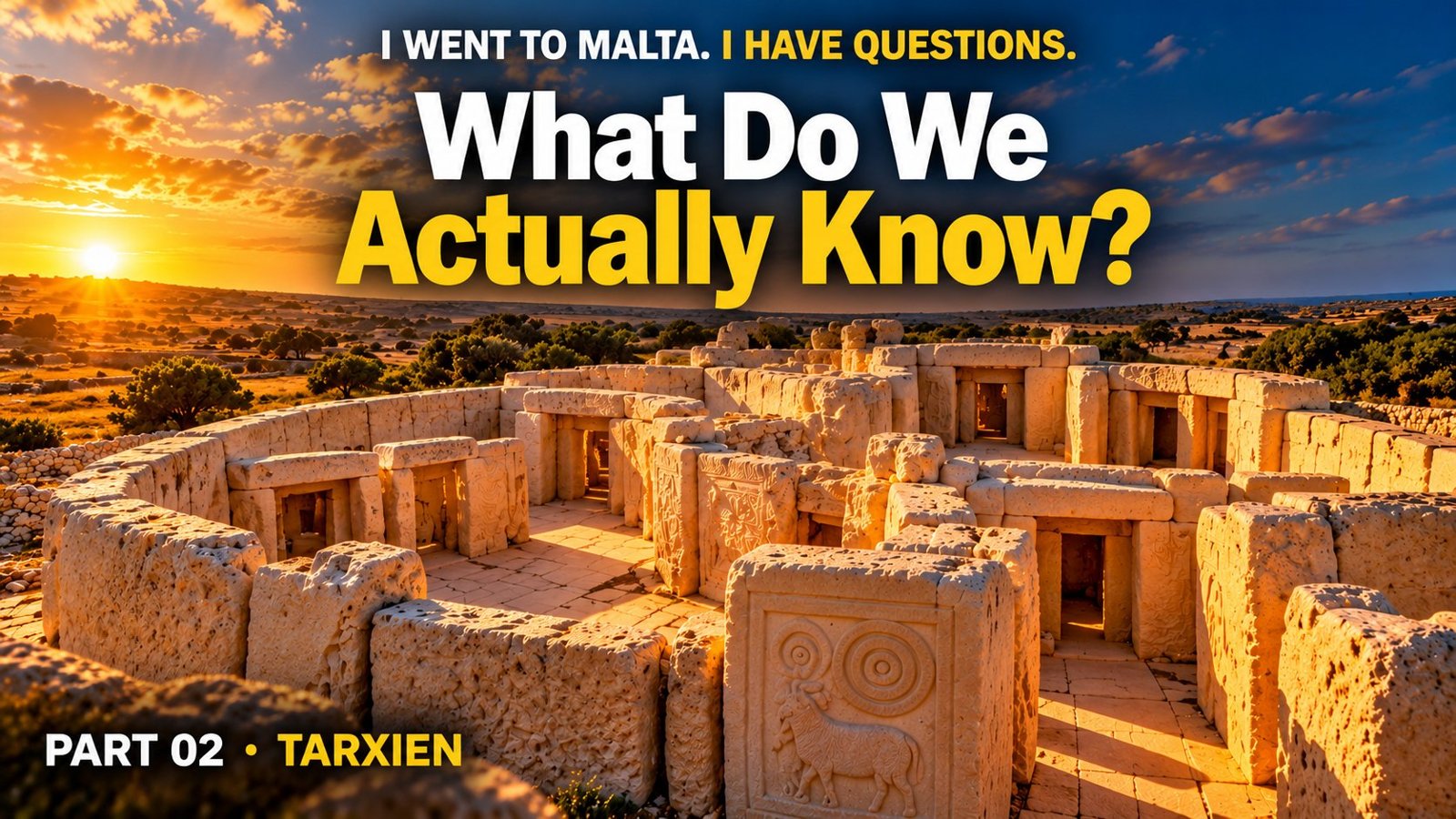
Some images in this series may be AI-generated to visualize historical settings and hypothetical reconstructions. Unless otherwise credited, they should not be mistaken for archaeological evidence.
I was standing at the temples of Tarxien in Malta with a friend, wondering how people had built something like this thousands of years ago.
"Ancient aliens," he said.
"Why would you say that?" I asked.
His reasoning was that the builders had no machines or technology, so someone from outside must have helped them.
Perhaps part of the difficulty is that we struggle to imagine how people lived and thought five thousand years ago. We look at what they accomplished through the lens of our own experience, with little understanding of how they approached problems, organized their lives, or understood the world around them. Yet these were people with brains much like ours, capable of creativity, ingenuity, experimentation, and solving complex problems. And when we can't picture how something was done, it's tempting to conclude that it couldn't have been done.
My instinct is to explore every plausible natural explanation before reaching for the supernatural. So I decided to go down the rabbit hole and find everything I could about how these temples were built, so you don't have to.
And whatever I couldn't explain, we could leave for the extraterrestrials.
But first: what do we actually know?
Start With the Evidence
Before I could even begin thinking about how the temples were built, I needed to know what archaeologists had actually uncovered. How old were these places? What survived? And how much of the story could those surviving pieces tell?
What Archaeology Tells Us
These Temples Didn't Appear Out of Nowhere
Here's the first thing that caught my attention: Tarxien belongs to a much longer story. Malta's temple-building tradition developed over centuries during the fourth and third millennia BCE. The Tarxien complex took shape in phases over that long period, rather than appearing fully formed in a single burst of inspiration.
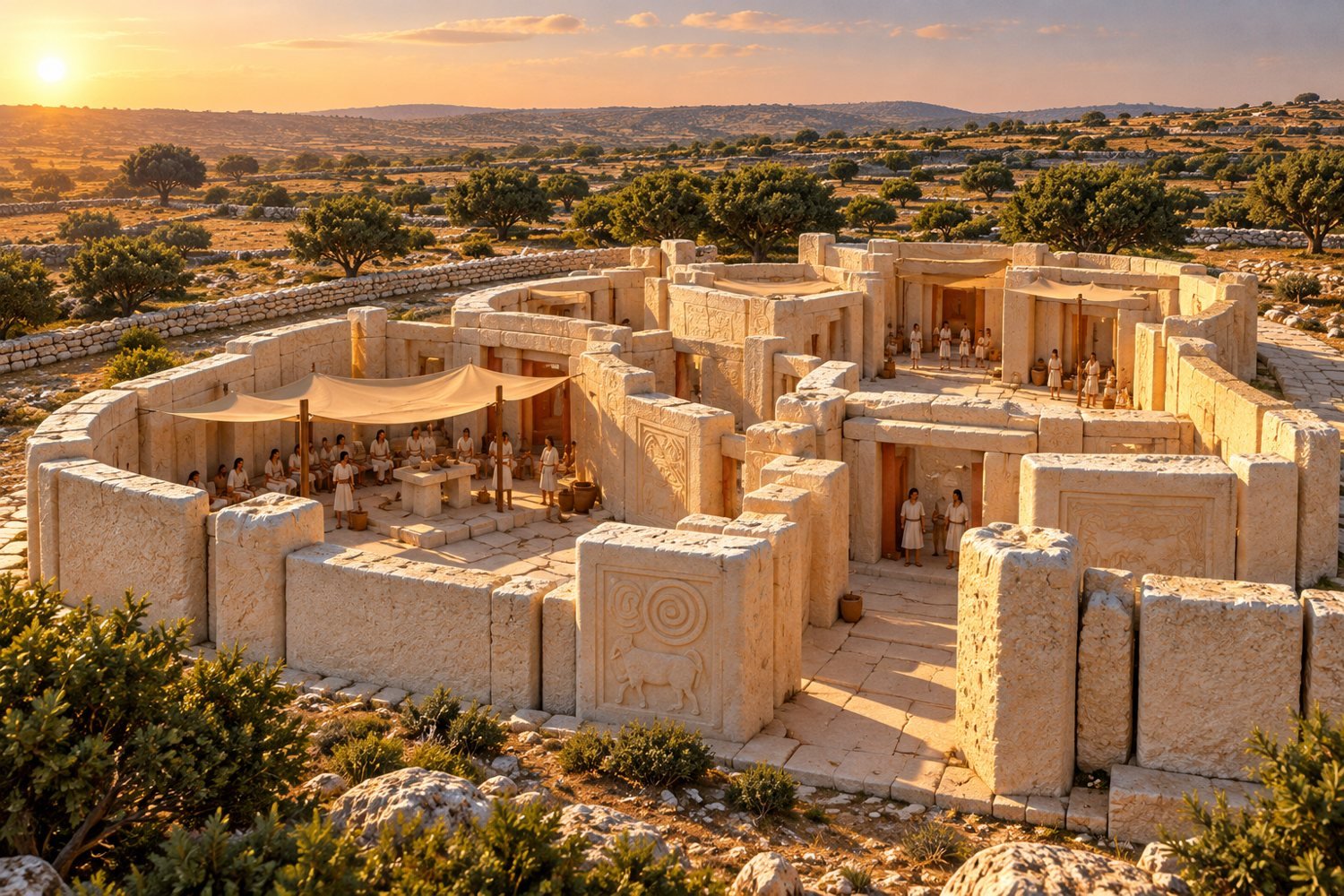 AI-generated conceptual reconstruction inspired by Tarxien. Architectural details and perishable structures are hypothetical.
Over generations, builders would have had opportunities to experiment, refine their methods, and pass along what they learned. We cannot reconstruct exactly how that knowledge was transmitted, but the archaeological sequence gives us good reason to think these monuments emerged from a developing tradition.
The Stones Have a Story to Tell
At Tarxien, the evidence is literally underfoot and all around you.
The complex consists of four megalithic structures, with curved chambers, substantial stone walls, intricate carvings, and fragments of monumental sculpture. Spirals and animal figures decorate some of the surviving stones.
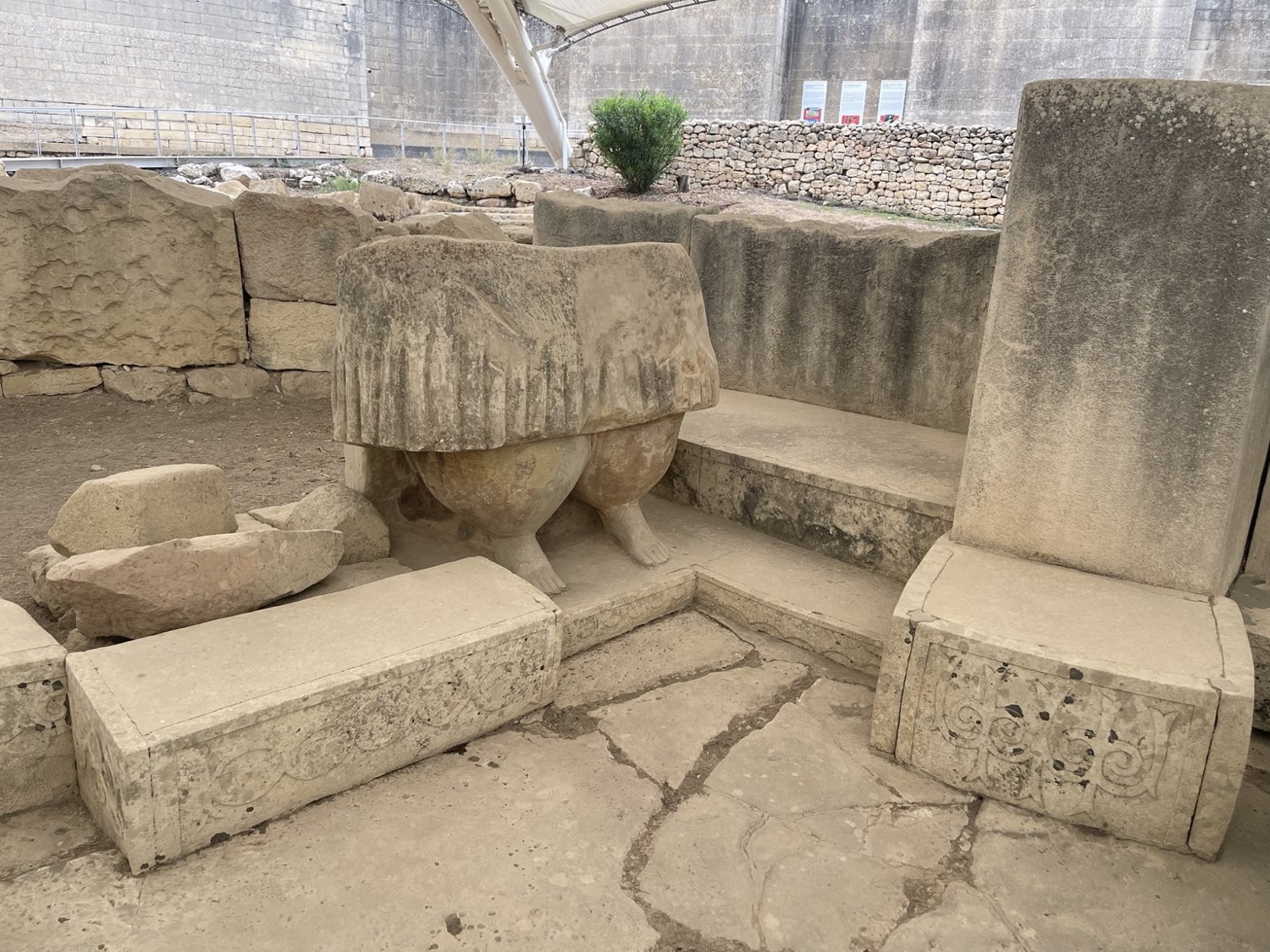 Replica of the monumental skirted figure at Tarxien. The original is housed at the National Museum of Archaeology in Valletta. Photograph by Ricardo Alcocer, September 2026.
But something else caught my attention: the builders understood the materials they were working with.
They worked with two local limestones: harder coralline and softer globigerina. Both appear in temple walls, while the softer globigerina was particularly suitable for detailed carving. Their use of these materials gives us a tangible glimpse of technical choices.
These people weren't simply stacking rocks. They were selecting materials, shaping them, arranging them into complex architectural spaces, and decorating those spaces with recognizable patterns and figures.
We can see the results of their work. What we cannot necessarily establish is every tool they used, every technique they developed, or precisely how they organized the construction process.
But Was It Really a Temple?
There's something about archaeology that has always made me curious: how do we know what ancient structures were actually used for?
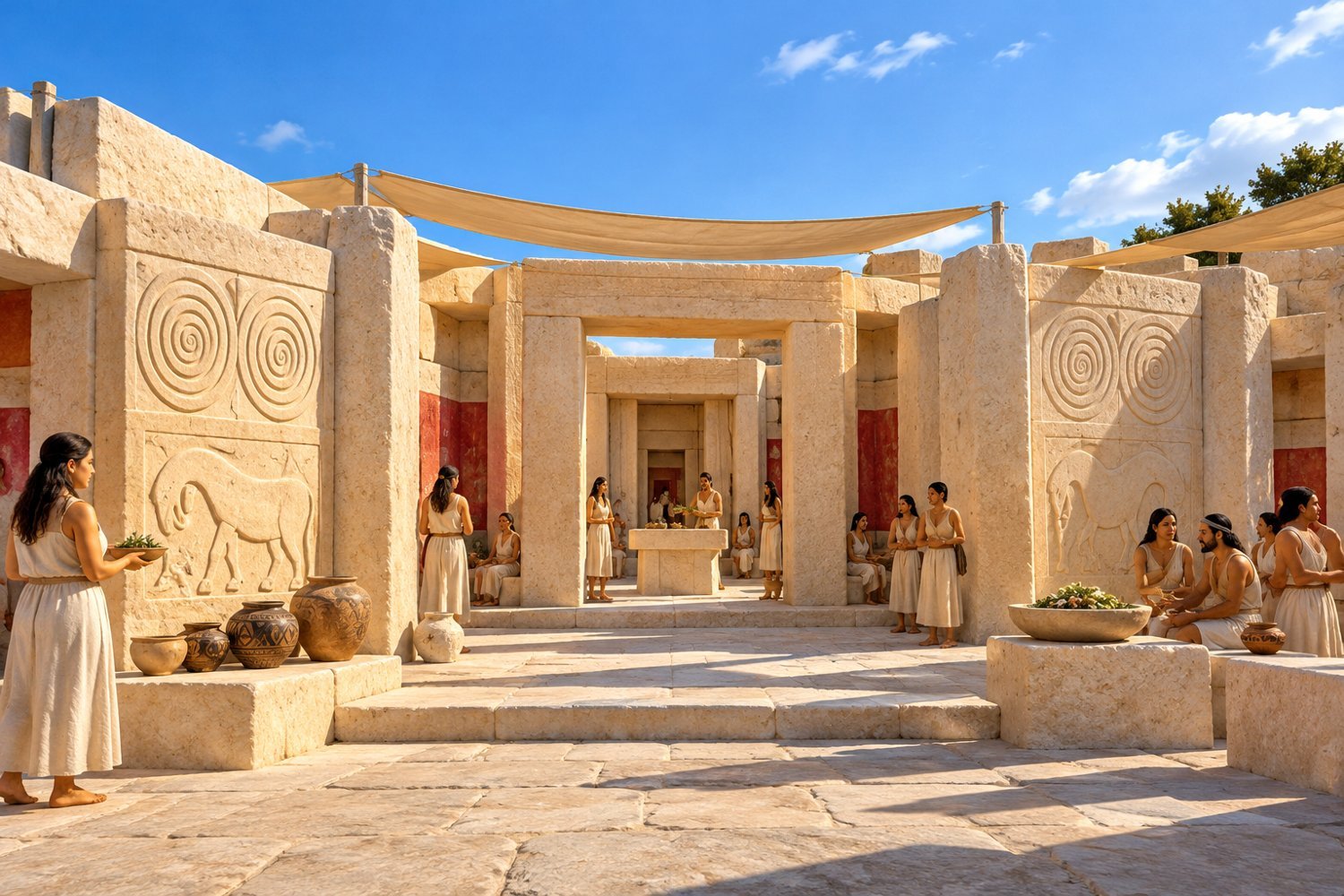 AI-generated hypothetical scene of communal activity at a Maltese megalithic complex. The activities depicted are speculative and do not represent established archaeological findings.
We call Tarxien a temple. But what makes it one?
Archaeologists have uncovered carved stones, animal imagery, architectural features, and other finds that researchers interpret as suggestive of ceremonial activities. Taken together, these discoveries provide reasons to interpret the complex as a place of ritual significance.
That interpretation deserves a closer look.
Consider something as ordinary as dealing with the dead. When archaeologists discover human remains, burials, or evidence of cremation, it's tempting to associate those findings with religious beliefs. And sometimes that interpretation may be correct.
But people also had practical reasons to dispose of their dead. Decomposition, scavenging animals, and the need to keep remains away from living spaces are concerns that require no supernatural beliefs whatsoever.
Of course, practical considerations and religious beliefs aren't mutually exclusive. People could have been motivated by both.
At Tarxien, there's an additional complication. After approximately 2000 BCE, parts of the complex were reused as a cremation cemetery in the Bronze Age, long after its original construction. Those later burials cannot automatically explain the intentions of the people who first built the structures.
And the question goes beyond burial practices. How do we distinguish a religious gathering from a communal feast? A ceremonial space from a meeting place? A sacred building from one that served several purposes?
The architecture, carvings, and archaeological discoveries give researchers legitimate reasons to propose ritual functions. But we have no written testimony from the builders explaining what happened inside.
We can examine the evidence, develop explanations, and test them against what we know.
But we should be careful about turning interpretations into facts simply because they've been repeated often enough.
The interpretation of Tarxien as a ceremonial or ritual complex is well supported by its architecture, carvings, and archaeological finds. What remains uncertain is the precise nature of those activities, the beliefs behind them, and whether the buildings also served other purposes.
The important thing is recognizing where the evidence ends and our interpretation begins.
What Survives Is Only Part of the Story
The surviving site has been excavated and conserved, and some elements have undergone modern restoration. A modern protective shelter now covers the site. What visitors see today needs to be understood alongside the excavation record.
Stone lasts. Rope, wood, fiber, and many other materials that could have been useful to builders often do not. The archaeological record is remarkably informative, but incomplete by its very nature.
That absence does not prove particular tools existed. It does mean we should be cautious about concluding that the builders had no technology simply because certain materials have not survived.
What We Still Don't Know
That brings me to the part I find most interesting: the boundary between what we can demonstrate and what we can reasonably imagine.
We can examine the stones, their arrangement, the marks left on them, and the wider archaeological context. But the precise sequence used to quarry, move, lift, and position each block remains uncertain. So do many details of the workforce: how labor was organized, how knowledge was passed on, and who made the decisions. The meanings of particular carvings and activities inside the temples are also open to interpretation.
A proposed method can be ingenious and still be wrong. To understand what happened here, we need to ask what evidence would support each explanation — and remain comfortable when the answer is that we don't yet know.
The more I looked at what survived, the more interested I became in the unanswered questions. The next one was also the most tangible: how did those enormous stones reach their final positions?
One Question Leads to Another
We know the stones got there. We know someone shaped and assembled them.
So how?
Next in the series: Getting the Stones There.
Reading a technology out of whatever survived is the same trouble as reading a solution when the problem is gone.
My friend's aliens are a mind filling a gap, the same reflex behind cargo cults and boxes that move on their own.
The reconstructions in this post are illustrations, not evidence, and photorealistic fiction keeps making that line harder to hold.
Sources and Evidence Notes
Dates and architectural development: UNESCO World Heritage Centre, Megalithic Temples of Malta. Dates are approximate, not precise construction-year determinations.
Site features and later cremation cemetery after approximately 2000 BCE: Heritage Malta, Ħal Tarxien Prehistoric Complex. The Bronze Age cemetery is a later phase and does not establish the Neolithic buildings' original purpose.
Limestone properties and the use of both stones in walls, with softer globigerina used for sculpture; shelter installation in 2015 and previous restoration interventions: Heritage Science, "Sheltering archaeological sites in Malta: lessons learnt" (2018).
Conservation, authenticity and restoration interventions: UNESCO World Heritage Centre. The terms "temple," "ceremonial," and "ritual" reflect scholarly interpretations rather than direct testimony about belief or purpose.
Preservation of perishable materials and questions about tools or lifting methods are general archaeological cautions, not evidence that any specific hypothetical device was used at Tarxien.
📬 Enjoyed this article?
Subscribe for the stuff that doesn't make it onto the blog — half-finished ideas, what I'm reading and listening to, behind-the-scenes notes, and the occasional rabbit hole. No spam, just things worth your time.