Hildegard of Bingen
A few weeks ago my wife came home talking about a movie she'd watched.
Apparently it was about a nun who invented IPA beer.
I assumed this was either a joke, internet mythology, or one of those "technically true" facts people use to annoy everyone at parties.
Turns out it was real.
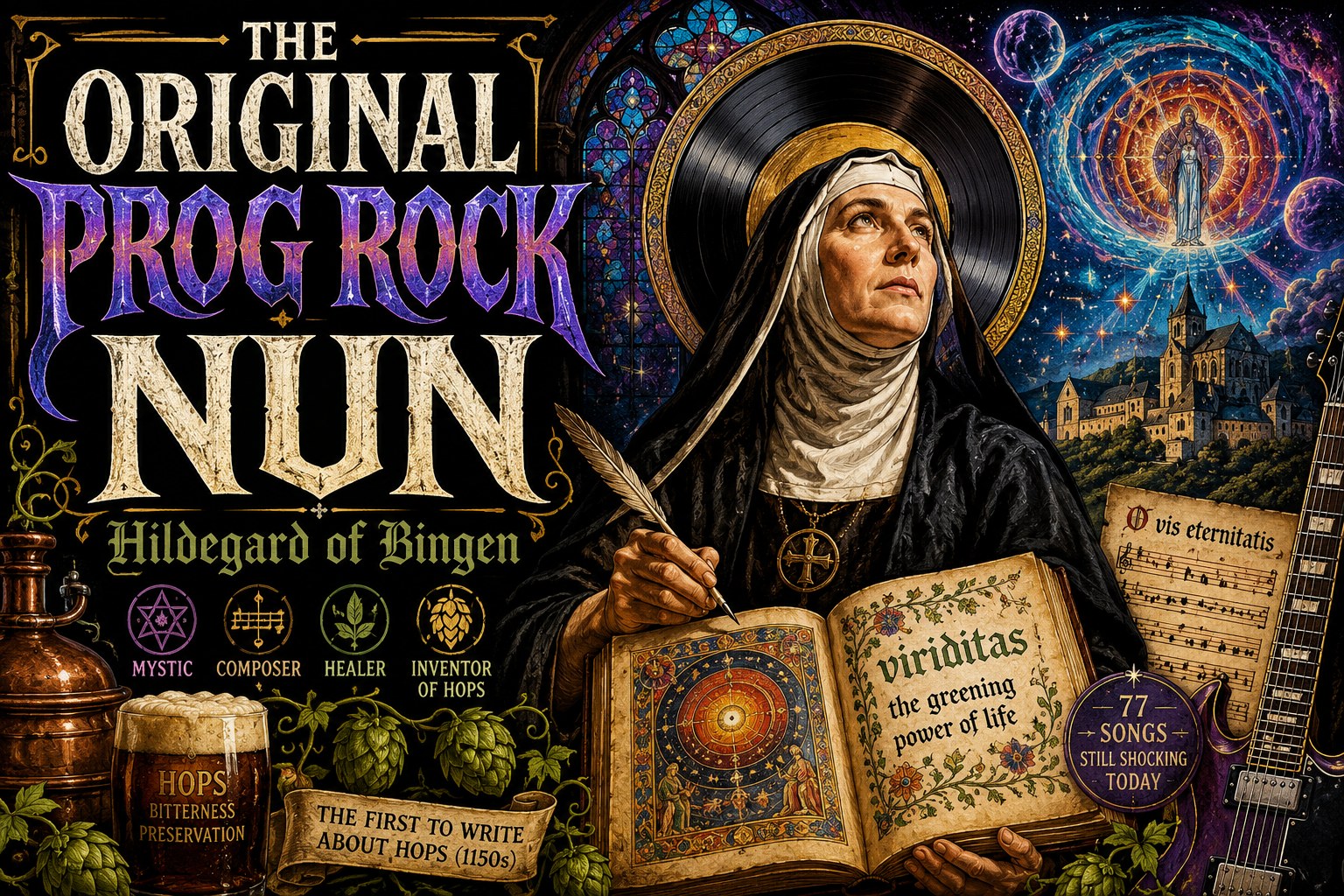
Her name was Hildegard of Bingen.
She was born in 1098 and spent most of her life inside monastery walls in what's now Germany. By all reasonable expectations, she should have disappeared into history completely.
Instead she somehow became a composer, philosopher, theologian, mystic, scientist, herbalist, playwright, political commentator, and — accidentally — part of the history of beer.
And somehow almost nobody talks about her.
From childhood, Hildegard claimed she experienced visions.
Not the soft Renaissance-painting kind either.
Her descriptions involve cosmic structures, living light, fire, giant symbolic beings, and imagery that honestly sounds closer to progressive rock album art than medieval Christianity.
The surviving illustrations from her manuscripts look like they belong on the side of a van owned by a guy who listens to nothing but Yes albums.
At one point she coined the term viriditas.
There's no perfect translation, but it roughly means something like "the greening power of life." The idea that all living things shared the same animating force. Plants, humans, nature, the cosmos — all connected through this living energy.
Which is fascinating because depending on how you frame it, it either sounds like medieval mysticism, proto-systems biology, or something you'd hear from a guy explaining mushrooms to you at 2AM.
And that was only one part of her life.
She also wrote music.
A lot of it.
Most medieval church music people imagine is slow, restrained, repetitive chant. Hildegard's compositions do something different. The melodies jump. Stretch. Climb. They feel strangely emotional and cinematic for music written almost a thousand years ago.
She wrote seventy-seven liturgical works and a musical morality play called Ordo Virtutum, which honestly feels suspiciously close to a concept album centuries before opera supposedly became a thing.
And the weird part?
It still sounds unique.
You can go listen to Hildegard recordings right now and they don't really sound like anybody else.
That's not normal for music written in the 1100s.
Then there's the medical side of her work.
Which gets even stranger.
While most people in medieval Europe were busy trying not to die from absolutely everything, Hildegard was documenting plants, nutrition, illness, emotions, and physical health in ways that feel surprisingly systematic for the time.
She wrote about herbs. Digestion. Emotional states. Human behavior.
She even wrote that certain emotional conditions could physically damage the body and that joy could help heal it.
Again: this is the 12th century.
Buried inside one of those texts is a passing mention of a plant called humulus lupulus.
Hops.
She noted that hops helped preserve beer and added bitterness.
That tiny observation became historically important because it's the earliest known written reference in Europe explaining what hops actually do in brewing.
Nine centuries later, every time I walk to Doble Malta here in Mexico City for my weekly Hazy IPA, I'm completing a chain that runs straight back to her.
History is weird.
She also had a reputation for refusing to stay quiet.
She wrote letters to emperors, bishops, and popes telling them when she thought they were wrong. She challenged church authorities. Founded her own convent. Traveled publicly to preach at a time when women were largely excluded from doing that entirely.
And she did all of this from inside a monastery.
The Catholic Church officially declared her a Doctor of the Church in 2012.
Only took about nine centuries.
What fascinates me most about Hildegard is the breadth.
Most historical figures get remembered for one thing.
Hildegard feels more like six different remarkable people accidentally merged into one human being.
Music alone would've been enough.
The visions alone would've been enough.
The medical writings alone would've been enough.
But somehow she did all of it.
And because she obsessively documented everything, we can still see the footprint she left behind almost a thousand years later.
Her music is still recorded.
Her writings are still studied.
Hops are still in your beer.
And modern audiences are still trying to figure out exactly what kind of person Hildegard of Bingen actually was.
Honestly, I'm not even sure she would've cared whether anyone remembered her.
Which somehow makes the whole story even better.
Her music still being recorded a thousand years later is the kind of creative afterlife I keep coming back to.
Hildegard survived nine hundred years through obsessive documentation, which is the same instinct behind leaving a stone for tomorrow.
She wasn't the only medieval writer whose ideas outran their century — the same is true of a 500-year-old book on critical thinking.
📬 Enjoyed this article?
Subscribe for the stuff that doesn't make it onto the blog — half-finished ideas, what I'm reading and listening to, behind-the-scenes notes, and the occasional rabbit hole. No spam, just things worth your time.