Getting the Stones There
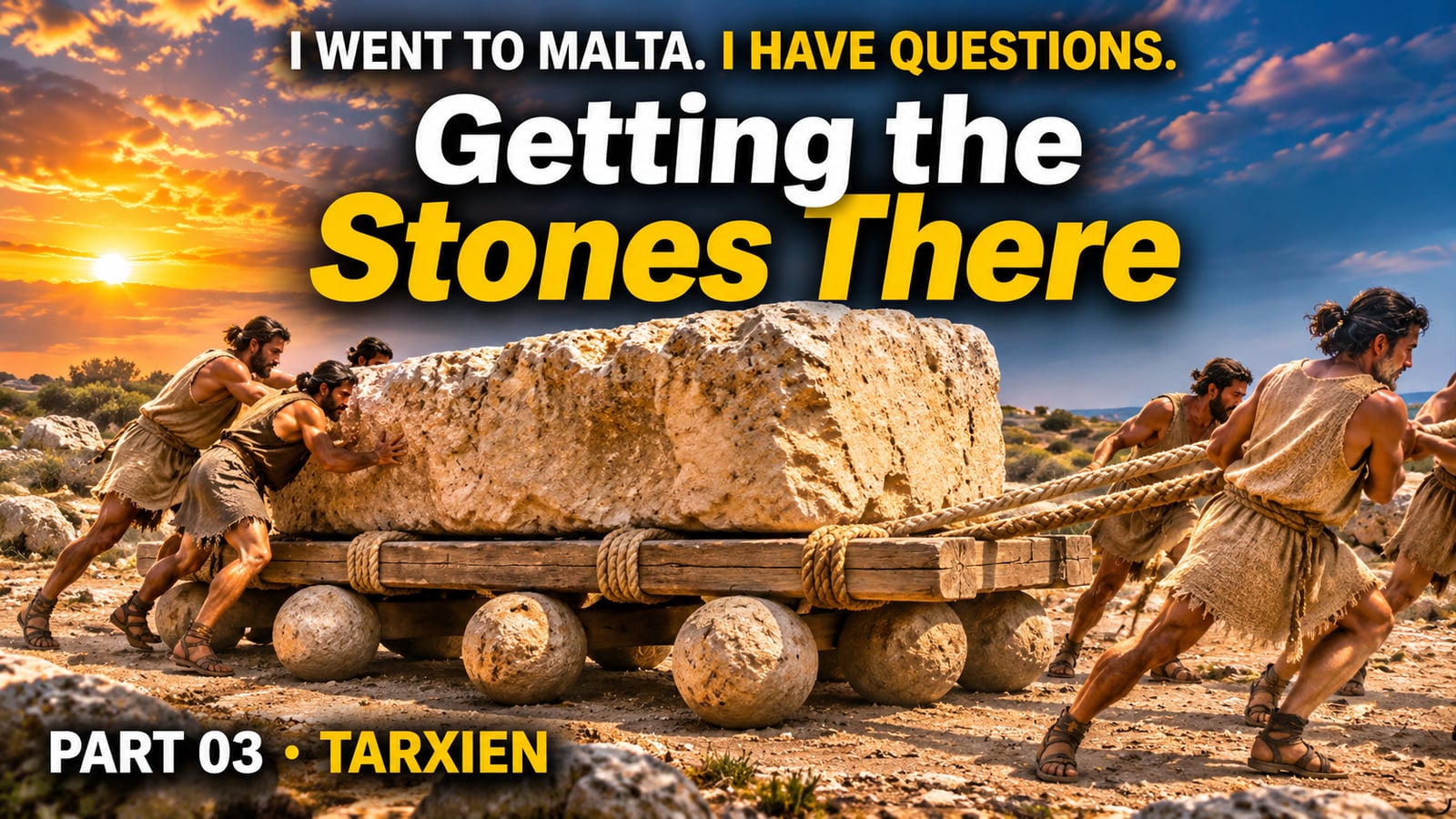
Some images in this series may be AI-generated to visualize historical settings and hypothetical reconstructions. Unless otherwise credited, they should not be mistaken for archaeological evidence.
Standing among the ruins of Tarxien, I found myself thinking about something that had to happen long before the first wall went up.
Somebody had to bring all those stones here.
Some of the blocks weigh several tons, and the people who built these temples more than five thousand years ago had no cranes, trucks, or metal tools. Yet they managed to obtain the stone, transport it, and eventually build something extraordinary.
I wanted to figure out how the first two steps might have worked.
First, get yourself a stone
Malta has plenty of limestone, which is convenient if you're planning to build a temple out of it.
The prehistoric builders used two main varieties: Globigerina limestone, relatively soft and easy to carve, and Coralline limestone, generally harder and more resistant to weathering.
They understood the differences well enough to select materials suited to different purposes.
In 2016, archaeologist Felice Larocca published a study of prehistoric stone percussion tools, including three recovered from Tarxien. One of them weighs more than five kilograms and has two opposing gripping areas.
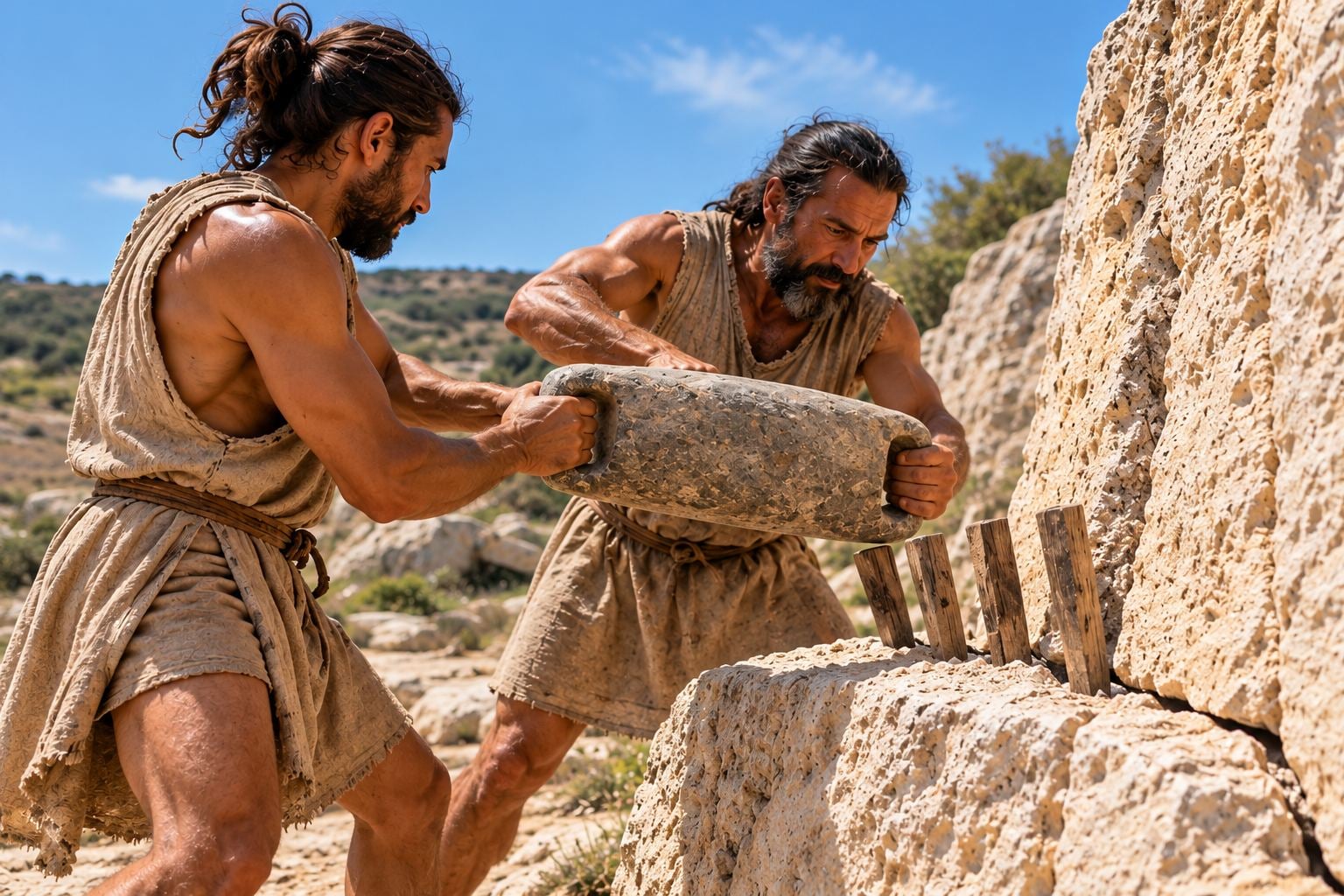 AI-generated hypothetical reconstruction of two workers operating a heavy stone percussion tool near wooden wedges. The handling and extraction method are speculative.
Larocca suggested that two people might have operated it together.
I would have liked to see that in action.
Larocca discussed possible uses for these tools, including working with wooden elements. Using them to drive wedges into limestone is plausible, but not demonstrated.
Wooden levers and plant-fiber ropes are other plausible tools, although the exact equipment used at Tarxien is unknown.
None requires advanced machinery.
Eventually, though, they'd have a large block of limestone lying on the ground.
Congratulations. Now comes the difficult part.
Two tons of trouble
Let's imagine a block measuring two meters long, one meter wide, and half a meter thick.
Depending on the limestone, it could weigh roughly 1.6 to 1.9 metric tons — nearly two tons.
How would you move it?
A team might drag it with ropes, perhaps on a wooden sledge over a prepared surface.
Another possibility is to use wooden rollers.
Logs placed beneath a platform could roll as the load advanced.
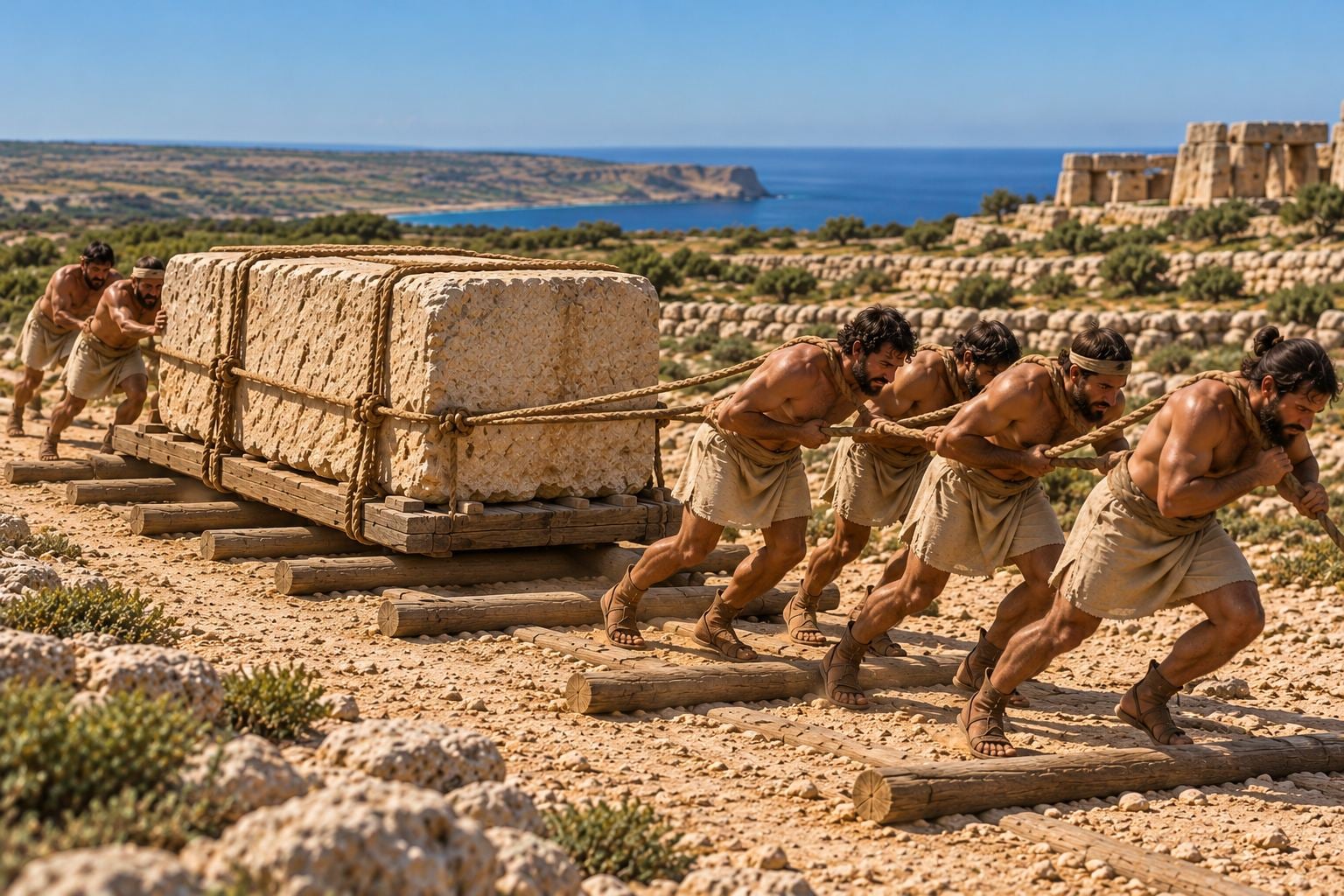 AI-generated hypothetical reconstruction of workers moving a limestone block on a wooden sledge and transverse timber rollers. This is a proposed transport method, not a documented procedure at Tarxien.
There is experimental evidence that rollers can work.
At Bougon, France, experimenters reportedly moved a 32-ton concrete block using wooden rollers and prepared tracks, with around 200 people involved.
A sledge could also reduce the difficulty of dragging stone over rough ground.
These are possible solutions, not proven Tarxien methods.
Then we get to the spheres.
The stone spheres
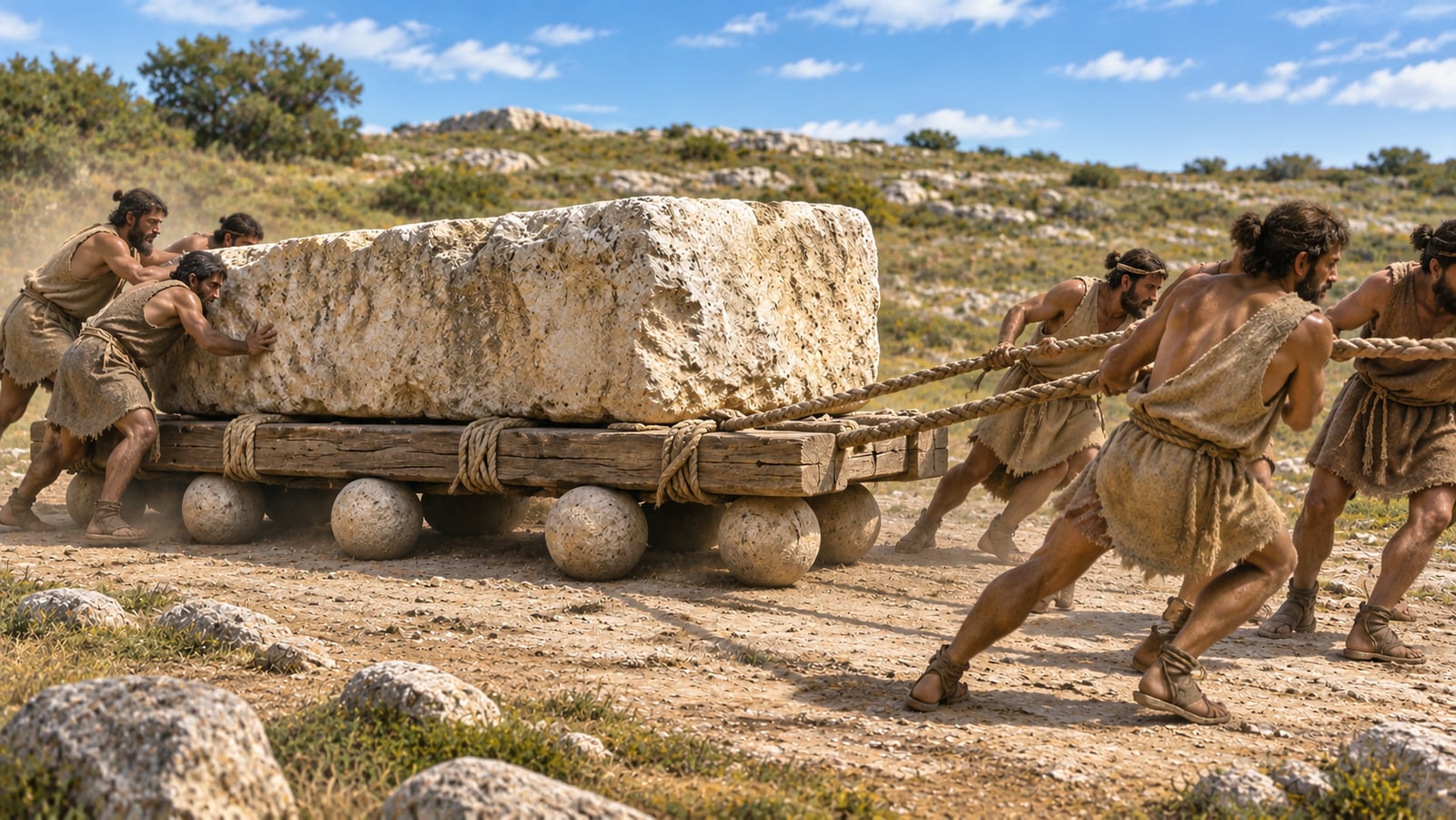 AI-generated hypothetical reconstruction of megalith transport using stone spheres. This method has not been demonstrated at Tarxien.
Archaeologists recovered rounded stone spheres at Tarxien and have suggested they might have served as rollers.
The spheres are real. Their proposed function remains a hypothesis.
Picture a heavy block on a platform supported by stone spheres. As workers pull, the spheres could roll beneath it.
As workers pull the platform forward, the spheres roll between the platform and the surface below.
Unlike a cylindrical roller, a sphere can roll in different directions.
That might help with steering or small adjustments.
David H. Trump described a stone roller beneath a large threshold slab in Tarxien's Central Temple. Intriguing — but the original context and later restoration complicate its interpretation.
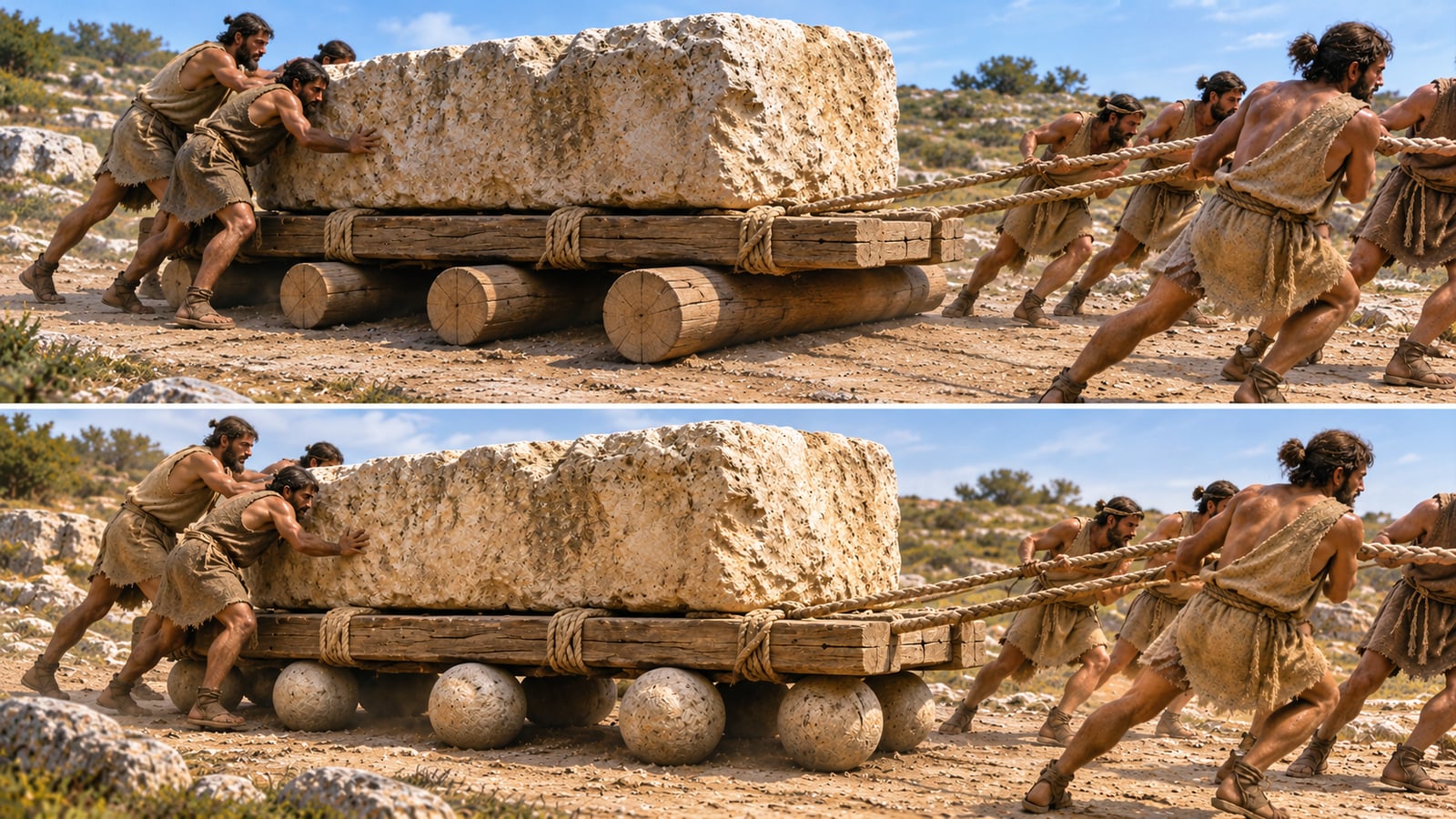 AI-generated hypothetical comparison: wooden rollers (top) and stone spheres (bottom). Neither method has been demonstrated at Tarxien.
We have limestone, stone percussion tools, possible wooden equipment, ropes, and several workable methods of moving heavy loads. We also have physical objects found at Tarxien that might have formed part of a transportation system.
It is tempting to connect these clues into a complete transport system. The evidence does not yet let us do that.
There are catches. Rollers work best on prepared ground; spheres need suitable surfaces and careful control on slopes. We do not know which quarry supplied any particular Tarxien block, or what route workers followed. Even Malta's famous cart ruts cannot be securely linked to this construction.
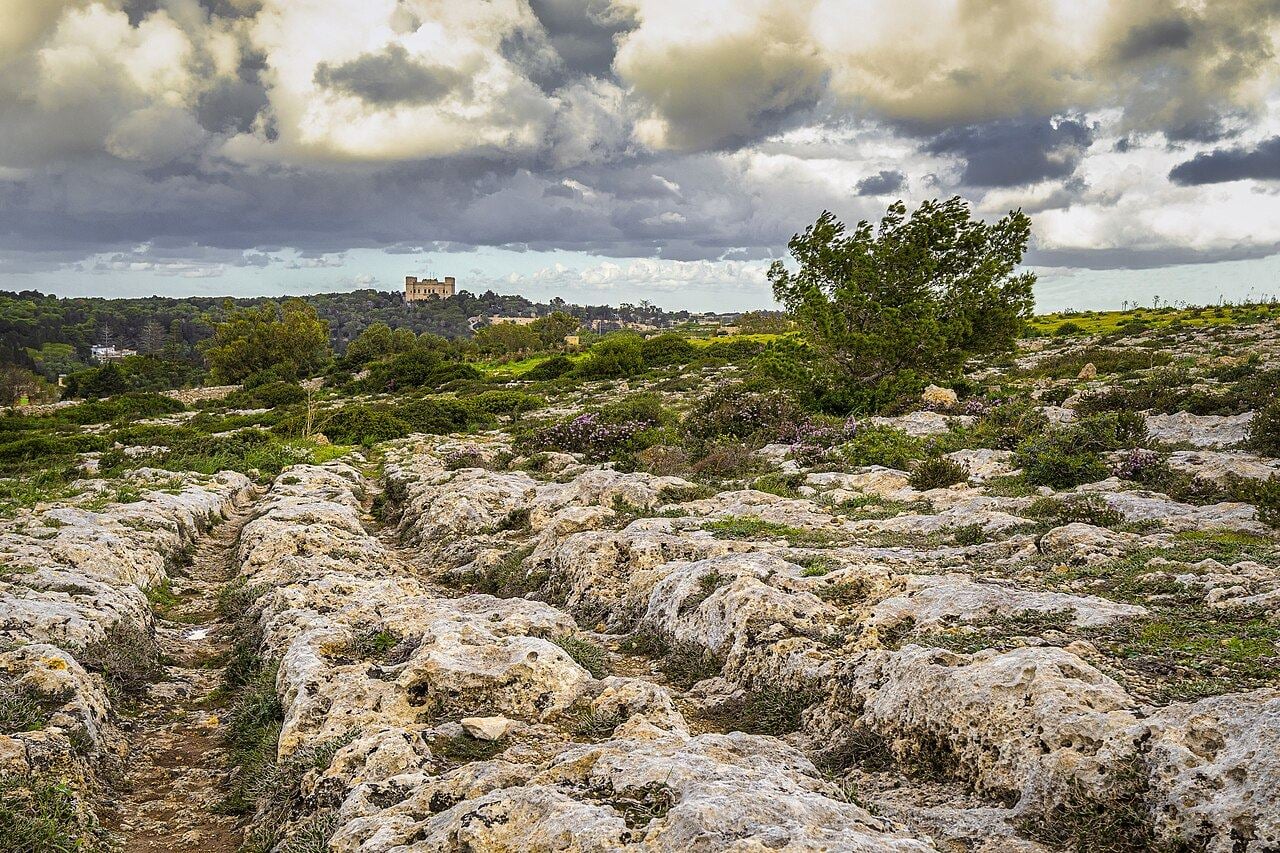 Cart ruts at Clapham Junction, Malta. Photograph attributed to Marika Caruana (2021), CC BY-SA 4.0, via Wikimedia Commons. These ruts are not evidence of the transport method used at Tarxien.

What the stones don't tell us
There's a limitation to this investigation that I've explored before in When the Problem Is Gone: ancient objects can survive long after the equipment, practices, and knowledge associated with them have disappeared.
Wood, rope, and plant fibers rarely survive as well as stone. Much of the equipment may have vanished.
Showing that a method works is not the same as proving it was used here.
The tools from Tarxien are real. The spheres are real. The experiments demonstrate that people can move enormous weights using relatively simple equipment.
What remains uncertain is how those pieces fit together at this particular site.
Getting there was only the beginning
We still don't know exactly how the builders transported the megaliths to Tarxien.
But simple tools and coordinated labor offer plausible ways to approach it.
If the spheres were used as rollers, they may be rare surviving traces of a system otherwise lost to time.
The stones made it to Tarxien.
And then the builders faced a new problem: how to raise them, position them, and assemble them into structures that would remain standing for thousands of years.
That's where we'll go next.
Stone outlasted the wood and rope that moved it, which is the whole argument for leaving a time capsule carved in stone.
The know-how vanished faster than the tools did, and that is what unsettles me about a craft dissolving into its own tooling.
Rebuilding a method from the few pieces that survived is the same habit as reading a story out of analytics.
Sources and Evidence Notes
Excavation reports and site description: Themistocles Zammit, "The Hal-Tarxien Neolithic Temple, Malta," Archaeologia 67 (1916), 127–144, doi:10.1017/S0261340900007785; "Second Report on the Hal-Tarxien Excavations, Malta," Archaeologia 68 (1917), 263–284, doi:10.1017/S0261340900008602; "Third Report on the Hal-Tarxien Excavations, Malta," Archaeologia 70 (1920), 179–200, doi:10.1017/S0261340900011085; and Prehistoric Malta: The Tarxien Temples (Oxford University Press, 1930).
Stone percussion tools, including the three from Tarxien and the suggestion that one was operated by two people: Felice Larocca, "Ground Stone Percussion Tools from Maltese Islands," Journal of Lithic Studies 3, no. 3 (2016), 291–300, doi:10.2218/jls.v3i3.1674. Larocca discusses possible uses including work with wooden elements; driving wedges into limestone is plausible but not demonstrated.
History of the roller hypothesis and the experimental work it rests on, including Bougon: Barney Harris, "Roll Me a Great Stone: A Brief Historiography of Megalithic Construction and the Genesis of the Roller Hypothesis," Oxford Journal of Archaeology 37, no. 3 (2018), 267–281, doi:10.1111/ojoa.12142. Experimental success elsewhere does not establish the method used at Tarxien.
Limestone properties: Lino Bianco, "Geochemistry, Mineralogy and Textural Properties of the Lower Globigerina Limestone Used in the Built Heritage," Minerals 11, no. 7 (2021), 740, doi:10.3390/min11070740.
Cart ruts and the open question of how they were made: Derek Mottershead, "The Origin of Maltese Cart-Ruts: Cut by Wheels or Tools?" Malta Archaeological Review 8 (2011), 43–48. The ruts cannot be securely linked to temple construction.
Site documentation: Heritage Malta, Ħal Tarxien Prehistoric Complex. The stone roller beneath the Central Temple threshold slab is described by David H. Trump; its original context and later restoration complicate the interpretation.
📬 Enjoyed this article?
Subscribe for the stuff that doesn't make it onto the blog — half-finished ideas, what I'm reading and listening to, behind-the-scenes notes, and the occasional rabbit hole. No spam, just things worth your time.