What Juan Tamariz Actually Did
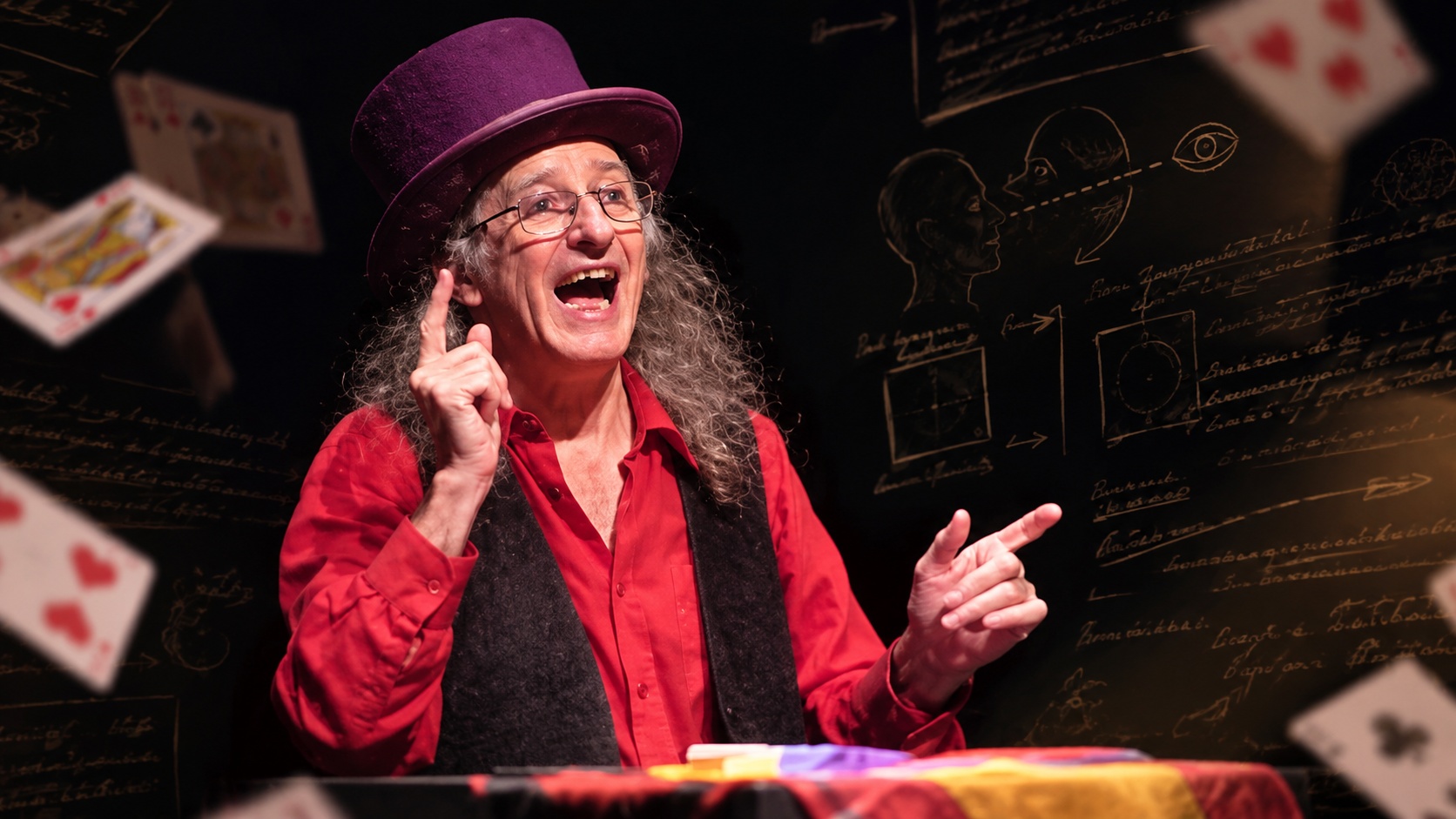
Juan Tamariz died less than two months ago.
If you know who he was, you probably remember the hair, the laugh, the chaos and the imaginary violin. If you only saw him perform on television, it would be easy to think that was the whole thing.
Tamariz was also one of the most influential thinkers in modern magic. Much of that work happened in a world almost nobody outside magic knows exists: magicians sitting around tables trying to understand what happens in the mind of a spectator when they see something they know should be impossible.
Tamariz spent decades thinking about that.
The trick is only the beginning
The obvious way to think about magic is that the magician knows a secret and you don't. Learn the secret, hide it well enough and you can fool people.
But hiding the method doesn't necessarily create good magic.
If I make a card disappear, your brain starts looking for somewhere to put it. Maybe it's in my other hand. Maybe I dropped it. Maybe you weren't looking at the card you thought you were looking at. Maybe the deck is special.
I can hide the method perfectly and still leave you with a reasonable explanation.
So what happens in your head after the card disappears?
That question became an important part of a tradition of Spanish card magic, and Tamariz spent much of his life exploring it.
This didn't start with Tamariz
Arturo de Ascanio, another Spanish magician whose name is almost completely unknown outside magic, had already approached card magic with unusual analytical rigor. Technique mattered, but so did timing, attention, naturalness and what the spectator experienced.
Tamariz considered Ascanio one of his teachers.
In 1971, the two were among seven magicians who founded the Escuela Mágica de Madrid. Despite the name, it wasn't a conventional school. It was a group organized around studying magic itself: working on problems, discussing theory, trying things, arguing about them and sharing what they discovered.
They even published a manifesto describing what they were trying to do. Roberto Giobbi attributes the original text to Tamariz, who apparently took inspiration from André Breton and the Surrealists.
The stated purpose was straightforward: study magic, improve it and find new possibilities for it.
For a bunch of guys doing card tricks, they were taking this very seriously.
What does the spectator think happened?
Once you look at magic this way, the questions change.
What did the spectator actually see? What do they think happened, and what explanations occurred to them along the way? Can you close those possibilities before they even realize they considered them?
Tamariz developed a systematic way of thinking about these explanations, which he called false solutions. Instead of simply hiding the real method, the magician identifies the explanations available to the spectator and tries to close them one by one.
He also thought about something I had never really considered part of designing a magic trick: memory.
What will the spectator remember tomorrow?
Tamariz was already writing about this in 1973. He described creating gaps in a spectator's memory and even causing people to remember details that hadn't actually occurred.
How someone reconstructs the trick afterward can be part of its design.
At that point you're thinking about something much more interesting than where the card went. You're thinking about the experience another person is going to have.
The crazy guy with the violin
This is what I now find hilarious about watching Tamariz.
He laughs, screams, interrupts himself, gets distracted, makes strange noises and plays an imaginary violin. Things seem to happen around him accidentally.
Underneath all of that is someone who spent decades thinking about when a spectator should look somewhere, what they should believe, which explanations should still be available and what they might remember later.
Once you know that, the chaos starts looking a lot less accidental.
Sharing the secrets
My own experience with magic was very different.
I became seriously interested in magic in Puerto Rico around 1988 and practiced it semi-seriously until 1996. For those eight years, information was hard to find. Books were hard to find. Much of what you could learn depended on who you knew and what that person was willing to teach you.
There was a hierarchy to knowledge. I assumed that was simply how magic worked.
Learning about Tamariz led me into the Spanish tradition around him, where I found a culture I didn't know existed.
They weren't revealing methods to audiences. Magic still depends on secrets. But among people seriously studying it, there was a strong tradition of exchanging ideas.
Tamariz traveled the world teaching other magicians. He lectured, wrote books and spent decades studying magic with other people.
In a 2019 interview, he described the attitude simply:
"Lo bonito es compartir."
The beautiful thing is sharing.
Coming from an art built around secrets, I find that particularly interesting.
The part most people will never know
That's why I wanted to write about Tamariz.
His contribution wasn't a particular trick or technique. It was a way of thinking about magic.
Attention. Memory. False solutions. What the spectator believes happened, what they will remember afterward, and how all of it can be considered when constructing an impossible experience.
Those ideas helped shape the way modern magicians think about their art.
That's a difficult kind of contribution to see from outside. You can watch someone perform a card trick influenced by this way of thinking and never know there's a whole body of theory underneath it.
Penn Jillette once summarized Tamariz's influence much more directly:
"Spain has the best magicians in the world. The reason is Juan Tamariz."
And then there's El Arcoíris Mágico.
I recently heard his daughter, Ana Tamariz, describe the book as her 40-year-old brother.
Juan spent roughly forty years writing it.
It's a massive book about magic with something rather unusual missing: tricks.
Instead, it's about the philosophy and psychology behind magic. What happens in the spectator's mind. How impossibility is constructed. The ideas Tamariz spent most of his life thinking about, testing and refining.
Forty years of thinking about why magic works.
A few weeks ago, I ordered a copy.
It arrived while I was traveling, and now it's sitting here with me.
I think I have some reading to do.
Tamariz's chaos hides its construction the same way the invisible scales of magic disappear once the art works.
His questions about attention and memory are the ones I chased from the other side in the brain's press secretary.
My own years of hoarded secrets eventually turned into a password-protected magic forum I ran in the late nineties.
📬 Enjoyed this article?
Subscribe for the stuff that doesn't make it onto the blog — half-finished ideas, what I'm reading and listening to, behind-the-scenes notes, and the occasional rabbit hole. No spam, just things worth your time.