We Thought Pocket Computers Would Make Us Smarter
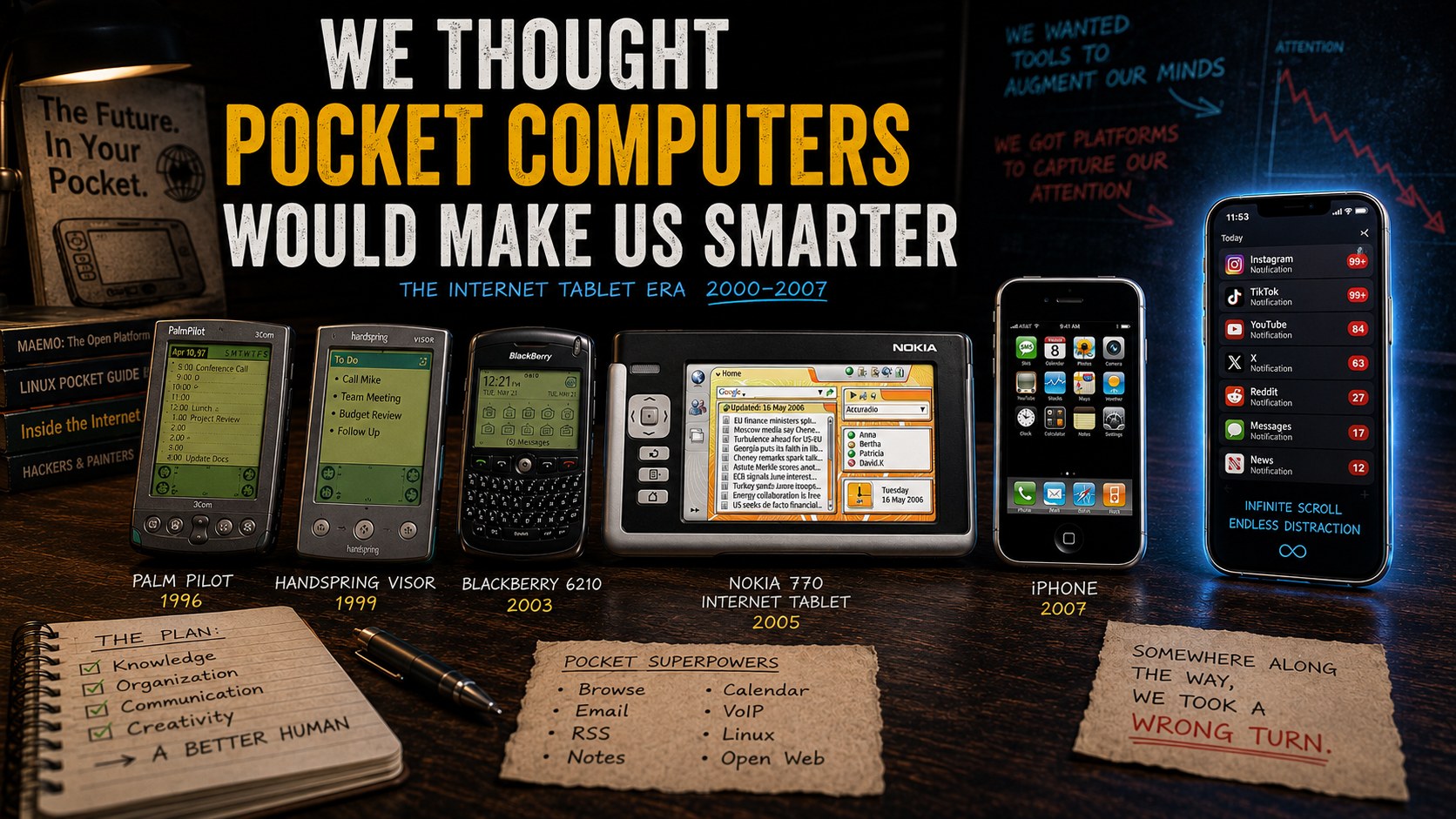
I still have my old Nokia Internet Tablet.
Calling it a smartphone would be generous.
It belonged to a strange evolutionary branch that most people barely remember now.
Back then, in the early 2000s, mobile computing still felt experimental. Optimistic. Intellectual, even.
Nobody fully knew what belonged in your pocket yet.
The industry couldn't even agree on what these things were for. Some companies bet on communication, others on portable media, others on gaming.
But there was another vision too:
A pocket computer designed to augment human thinking.
That was the feeling behind devices like the PalmPilot, the Handspring Visor, early BlackBerry devices, Pocket PCs, and especially the Nokia Internet Tablet line.
My Nokia tablet felt less like a phone and more like carrying a tiny Linux workstation around.
It had:
- internet access,
- RSS feeds,
- web browsing,
- notes,
- calendar synchronization,
- messaging,
- even SSH access.
At the time, it genuinely felt like we were building a second brain.
The direction seemed obvious. Kids growing up surrounded by this stuff would naturally turn out more technical, better informed, more connected, intellectually empowered — with calendars, maps, searchable memory, instant communication, synchronization, and almost all human knowledge available at any moment.
Surely this would make people less gullible. Less dependent on superstition, less trapped by geography and local narratives, harder to manipulate.
Technology improves → humans improve.
That assumption now feels incredibly naive.
Because evolution — technological or biological — is never linear.
Nobody planned for pocket computers to evolve into civilization-scale attention extraction systems.
And yet that's partially what happened.
The early internet felt like civilization upgrading its nervous system.
Today it sometimes feels like civilization trapped inside its own nervous system.
The most profitable use of a portable supercomputer turned out to be engagement.
The smartphone fulfilled the hardware dream while betraying the software dream.
The hardware became miraculous: GPS, cloud synchronization, HD cameras, instant communication, real-time collaboration, global knowledge, AI.
The human outcomes became strangely contradictory. We carry all the information in the world on devices that have shredded our attention spans. We can talk to anyone anywhere, and relationships feel thinner than ever. There's a productivity tool for everything, and chronic disorganization anyway. Maps in every pocket, and a fading sense of where we are. Calendars synced across every device we own — and still, somehow, everyone is late.
And maybe the strangest part is that the original vision wasn't wrong.
For a while, these devices genuinely felt like tools for becoming more capable humans.
Then, slowly, the incentives changed.
The internet stopped optimizing primarily for utility and started optimizing for attention.
Notifications survived. So did infinite scroll, outrage, engagement.
They survived for one reason: they were evolutionarily successful inside the economic ecosystem of the modern web.
And somewhere along the way, the relationship inverted.
We thought we were designing tools.
But the tools were redesigning us.
The second-brain dream survived, by the way — it just moved into a reading archive I actually own.
The tablet isn't my only early-2000s ghost — Konfabulator got a second act two decades later.
And if you're wondering where all that promised human flourishing went — the feed became the destination.
📬 Enjoyed this article?
Subscribe for the stuff that doesn't make it onto the blog — half-finished ideas, what I'm reading and listening to, behind-the-scenes notes, and the occasional rabbit hole. No spam, just things worth your time.