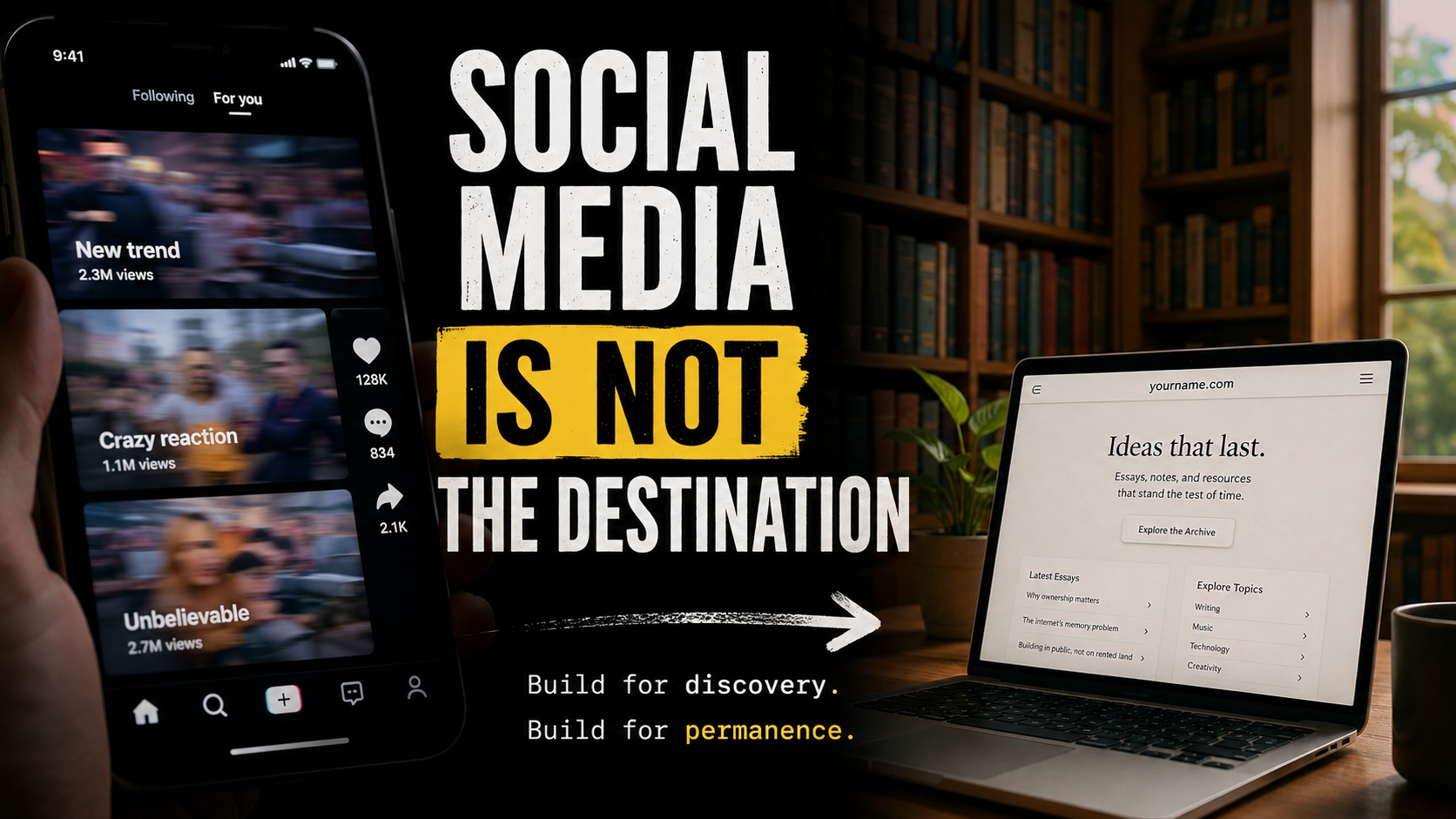
Social Media Is Not the Destination
A few weeks ago I was reading one of those analyses of how MrBeast approaches YouTube. The amount of detail was honestly impressive. Thumbnail testing. Retention curves. Audience drop-off points. Constant experimentation. Entire systems built around understanding exactly when human attention drifts away.
And to be clear, this is not criticism. The guy clearly understands the modern internet better than almost anyone alive.
But while reading all of it, I kept thinking about something else.
Almost every recommendation was about helping content survive inside the feed.
Not outside of it.
That distinction feels increasingly important to me because I think a lot of creators slowly started confusing social media with the actual destination. It was originally supposed to point people somewhere else. Your website. Your store. Your mailing list. Your forum. Your music. Your actual body of work.
Instead, the feed became the place where the work itself lives.
Take something as normal as the phrase "link in bio." People say it constantly online and nobody really stops to think about how strange that concept actually is.
If someone discovers your post six months later, the link in the bio probably points somewhere completely different now. The post survives, but the context disappears.
Imagine reading a book where the footnotes changed every two days. That would sound ridiculous. Yet that's basically how large parts of the modern internet now function.
The problem is not social media itself. Social media is incredibly useful. I use it every day. The problem is that these systems are optimized almost entirely for recency. For movement. For constant replacement.
Today replaces yesterday. Tomorrow replaces today.
The feed never really arrives anywhere. It just refreshes forever.
And of course creators adapt to this environment because they have to.
A musician spends weeks recording a song and eventually realizes the fifteen-second clip promoting the song gets more engagement than the song itself.
A writer compresses years of experience into a carousel post because nobody clicks external links anymore.
A photographer spends days perfecting an image that people consume in less than a second while half-paying attention in line at a supermarket.
Eventually the incentives start shaping the work itself.
Depth becomes risky. Nuance becomes inefficient. Complexity becomes harder to justify.
Everything slowly moves toward shorter, faster, louder, more immediate.
And audiences adapt too.
I think this is the part people often avoid talking about honestly. Users love saying they care about thoughtful writing, journalism, music, independent creators, meaningful conversation, and quality work. But if you observe actual behavior online, most people are not really looking for depth.
They're looking for stimulation.
Something interesting for the next few seconds before moving on to the next thing.
And I'm not even saying this morally. I think the systems trained us this way over time. Infinite feeds reward novelty, interruption, emotional spikes, outrage, surprise, speed. After enough years inside these environments, that rhythm starts feeling normal.
But I do think many users fail to critically examine the digital environments they now spend enormous portions of their lives inside.
People think they are consuming information. A lot of the time they are consuming moments.
Tiny bursts of attention that disappear almost immediately after consumption.
Meanwhile, older versions of the web felt very different. Websites accumulated. Blogs accumulated. Forums accumulated. You could find a random article written fifteen years ago and still disappear into an entire network of connected ideas.
The internet felt less disposable back then.
Less like a river.
More like a city.
Places existed. You could return to them.
That's why I increasingly think social media works best as a top-of-funnel mechanism rather than the final destination. The feed is incredibly powerful for discovery. But discovery without somewhere meaningful to arrive eventually starts feeling hollow.
Especially now that AI can generate infinite amounts of disposable content.
Because if the entire internet becomes optimized for today's attention, then permanence itself may become one of the rarest and most valuable things left.
I made the same argument about music, where streaming platforms aren't a home either — just another feed with an algorithm as the stage manager.
The antidote is ownership, which is exactly why I moved my reading archive off a service I didn't control and into something I actually own.
And if permanence is what's becoming scarce, the most honest version of it might be carving something into stone for tomorrow.
📬 Enjoyed this article?
Subscribe for the stuff that doesn't make it onto the blog — half-finished ideas, what I'm reading and listening to, behind-the-scenes notes, and the occasional rabbit hole. No spam, just things worth your time.