On Treating Time as a Finite Resource
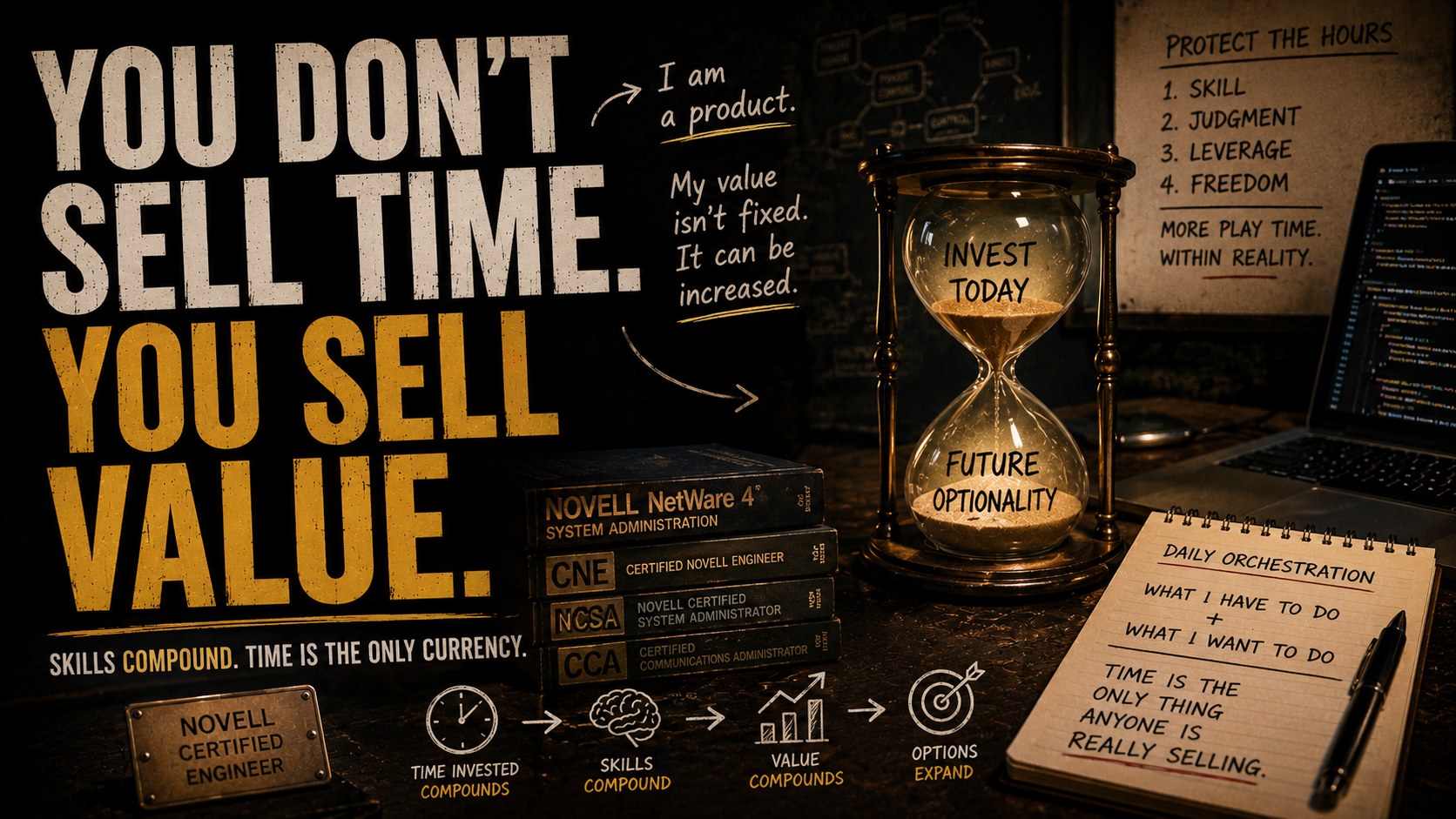
Early in my career, my mentors were Novell-certified engineers.
That detail matters.
They came from a time when skills were scarce, verifiable, and unforgiving. You didn't claim expertise—you demonstrated it. You passed exams, configured systems, and kept networks alive. If you had a skill people needed, it became obvious very quickly. If you didn't, that also became obvious just as fast.
They understood what it meant to possess a skill the world actively wanted.
And they instilled something in me that stayed:
I am a product.
Not in a branding sense. In the craft sense.
My value wasn't fixed. It could be increased through knowledge, experience, and judgment. Jobs and salaries weren't goals—they were signals. I treated my time as an investment in growing in ways that made my contribution increasingly difficult to replace.
Not by doing more of the same work, but by accumulating a specific combination of skills, context, and judgment that only time can produce.
That idea never left.
The Quiet Contract with Work
Early on, I held three different jobs.
Later, I ran my own company for eleven years.
Seeing both sides of the table changes how you understand work.
When you're an employee, time feels like something you give. When you're the employer, time is the only thing anyone is really selling.
Effort becomes less interesting. Outcomes, judgment, and trajectory take over.
Tenure doesn't create value—growth does.
That experience stripped work down to its essentials.
You Don't Sell Time. You Sell Value.
As a software engineer, you don't sell hours.
You sell outcomes.
If something takes you fewer hours than anyone else, you don't charge less—you charge more. Not because the work was harder in that moment, but because the years required to make it look easy were expensive.
Speed is a side effect of competence, and competence is accumulated time.
The fewer hours it takes you to solve a hard problem, the more time was likely invested long before the problem existed.
Once you see that, it becomes impossible to think about time the same way again.
Time Is the Only Real Currency
Everything I value—skills, leverage, optionality, confidence—came from how I used my time.
Time isn't money. Money is just one of its byproducts.
An hour spent honing a skill compounds quietly. An hour spent consuming collapses into the present and disappears.
Neither is immoral. Confusing them is costly.
You Don't Escape Time Management
Every day, you orchestrate what you want to do with what you have to do.
Whether you acknowledge it or not, you're already doing time management.
Some days deliberately. Most days by inertia.
Even procrastination is a decision—it simply delegates authorship to habit.
There is no neutral day.
Productive vs. Entertainment (And the Point Everyone Misses)
For me:
- Productive time increases future optionality
- Entertainment time collapses experience into the present
Both are necessary.
The mistake isn't entertainment. The mistake is pretending it doesn't need limits.
Once you can clearly identify which is which, the next step is obvious: you limit entertainment time—on purpose.
Not eliminate it, constrain it.
Entertainment doesn't compound. Skills do.
Left unchecked, entertainment expands to fill every unguarded hour. Productive time never does—it has to be defended.
Ultimately, that defense isn't about working more. It's about protecting a different outcome: free time.
When the mind is free, that's when the interesting things happen. That's when you can see yourself from a distance. That's when clarity shows up—and pieces like this one can be written.
The Existential Undercurrent
I don't believe meaning is assigned. I don't believe there's a scoreboard waiting at the end.
Meaning has to be built, and time is the raw material.
How you spend it is one of the few places where agency is real. Skills don't respond to intention, they respond to hours invested.
Time spent not honing skills isn't neutral. It's a quiet vote for the current version of yourself to remain unchanged.
No guilt. No drama. Just physics.
Closing
At a personal level, I experience life as a kind of playground.
Not because it's easy, but because curiosity, experimentation, and reflection are where I do my best thinking.
The world, however, operates under different rules. Value has to be created. Constraints have to be respected.
Time has to be earned before it can be freely spent.
So the optimization isn't for escape. It's for more play time—within reality.
Seventeen years after I published a book, someone downloaded a copy — proof that compounded time shows up in unexpected places.
A magician's invisible practice is the cleanest example of competence accumulating into something that looks effortless.
Then 2025 hit, and the craft I'd spent thirty years compounding got reshaped overnight.
📬 Enjoyed this article?
Subscribe for the stuff that doesn't make it onto the blog — half-finished ideas, what I'm reading and listening to, behind-the-scenes notes, and the occasional rabbit hole. No spam, just things worth your time.