LinkedIn Has a Problem
I joined LinkedIn on January 5, 2004, when the company wasn't even a year old.
Years later, I lived down the street from one of its buildings in Sunnyvale and watched it being built. I've been around long enough to watch LinkedIn grow into something every professional is expected to have.
And apparently, one of my old companies is doing fantastic.
Bonobo is having a great year
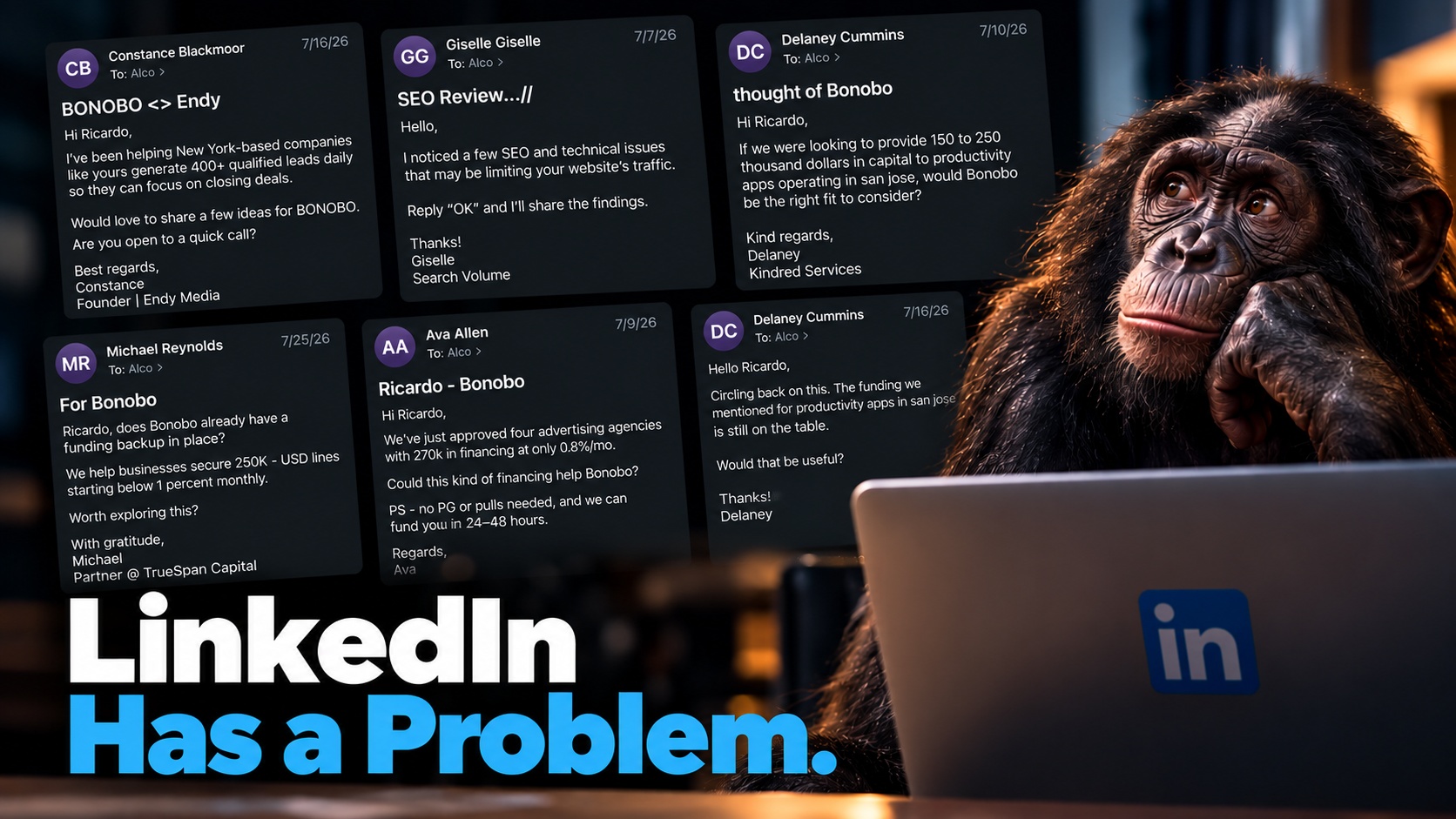
Bonobo is the last project listed in the experience section of my LinkedIn profile. Judging by my inbox, business is booming.
Someone wants to generate 400 leads a day for us. Someone else has identified SEO problems that may be limiting traffic to our website.
Several companies would like to lend us money. $250,000. $270,000. One particularly generous follow-up offered $1 million.
Others want to help us expand our development capacity, or have apparently been researching companies just like ours.
There's just one problem.
Bonobo hasn't existed for years. Its website has been offline for more than three.
So yes, we probably do have some SEO issues.
I suspect my LinkedIn profile ended up in one or more prospecting databases. Somewhere along the way, automated systems associated my name with Bonobo and decided we were a promising business opportunity.
Nobody bothered to check whether the company still existed.
And I receive messages like these almost every day.
The boy who cried wolf
Imagine receiving a message from someone who says they've been following your work and would love to connect.
Twenty years ago, that might have been enough to get my attention. Today, my first instinct is to assume the message was generated automatically.
After enough emails praising a company that no longer exists, you start questioning every supposedly personalized message that arrives.
Eventually, someone who genuinely knows your work will reach out. Perhaps they read something you wrote, or have an interesting project they'd like to discuss.
And there's a good chance you'll delete their message without reading it.
The machines have trained us to treat humans like machines.
Some of these emails even make a special effort to sound human.
"Bad timing? Hit me with 'Nope.'"
"With gratitude."
One ends with a smiley.
Others invite me to unsubscribe or reply with "stop." But I never subscribed to these emails, and responding to an unknown sender can confirm that someone is actively reading my address. If it came from a purchased or leaked list, that's information I'd rather not provide.
I don't even trust the invitation to make the messages stop.
That's an impressive amount of distrust to pack into a single email.
When nobody believes the messages
Professional networking always had a cost built into it: the effort someone spent before reaching out. If a message mentioned a project I'd worked on, I could reasonably assume they'd taken a few minutes to look into it.
Today, an automated system can collect thousands of profiles and generate personalized messages for practically nothing.
And as recipients become more skeptical, senders have an obvious incentive to improve their automation. More data, better prompts, increasingly sophisticated personalization and even more messages.
The more messages we receive, the less attention we give them. Legitimate communication gets buried alongside everything else.
For a platform whose value depends on professional connections, that's a serious problem.
You need to be on LinkedIn
People still tell me LinkedIn is essential for professional networking. Depending on what you're trying to accomplish, they may have a point.
Recruiters need somewhere to find candidates. Former colleagues occasionally want to reconnect, and it's convenient to have a place where someone can look up your professional background.
But how much of that actually requires a social network?
A directory would accomplish most of it.
I suspect LinkedIn is gradually becoming an enormous professional bulletin board where everyone maintains a presence because everyone else maintains one.
The platform could continue growing, with millions of people posting, commenting and connecting, while the actual value of those interactions declines.
Eventually, having a LinkedIn profile could become something like having a business card. You keep one because it's useful when somebody asks for it, even if you rarely think about it otherwise.
And when someone asks whether you're on LinkedIn, you'll probably answer:
"Yeah. I'm there just in case."
I stopped updating my professional experience around 2022 because I'm not looking to get hired. My contact information is current, though, and I still check my notifications a couple of times a month.
Which means I'm already using LinkedIn as the bulletin board I suspect it's becoming.
And apparently Bonobo is doing great.
The website has been offline for more than three years, but we're raising capital, fixing our SEO, generating leads and expanding development capacity.
I should probably check LinkedIn to see how we're doing.
The reason I'm wary of clicking unsubscribe is the same one I learned the hard way in 2004, when I figured out you could track emails with invisible images.
This is also why I keep arguing that social media is not the destination — the profile is a pointer, not the place.
And it rhymes with what happens to musicians: the platform doesn't care about you, it cares about the feed.
📬 Enjoyed this article?
Subscribe for the stuff that doesn't make it onto the blog — half-finished ideas, what I'm reading and listening to, behind-the-scenes notes, and the occasional rabbit hole. No spam, just things worth your time.