I Gave ChatGPT a Book I Wrote in 2009
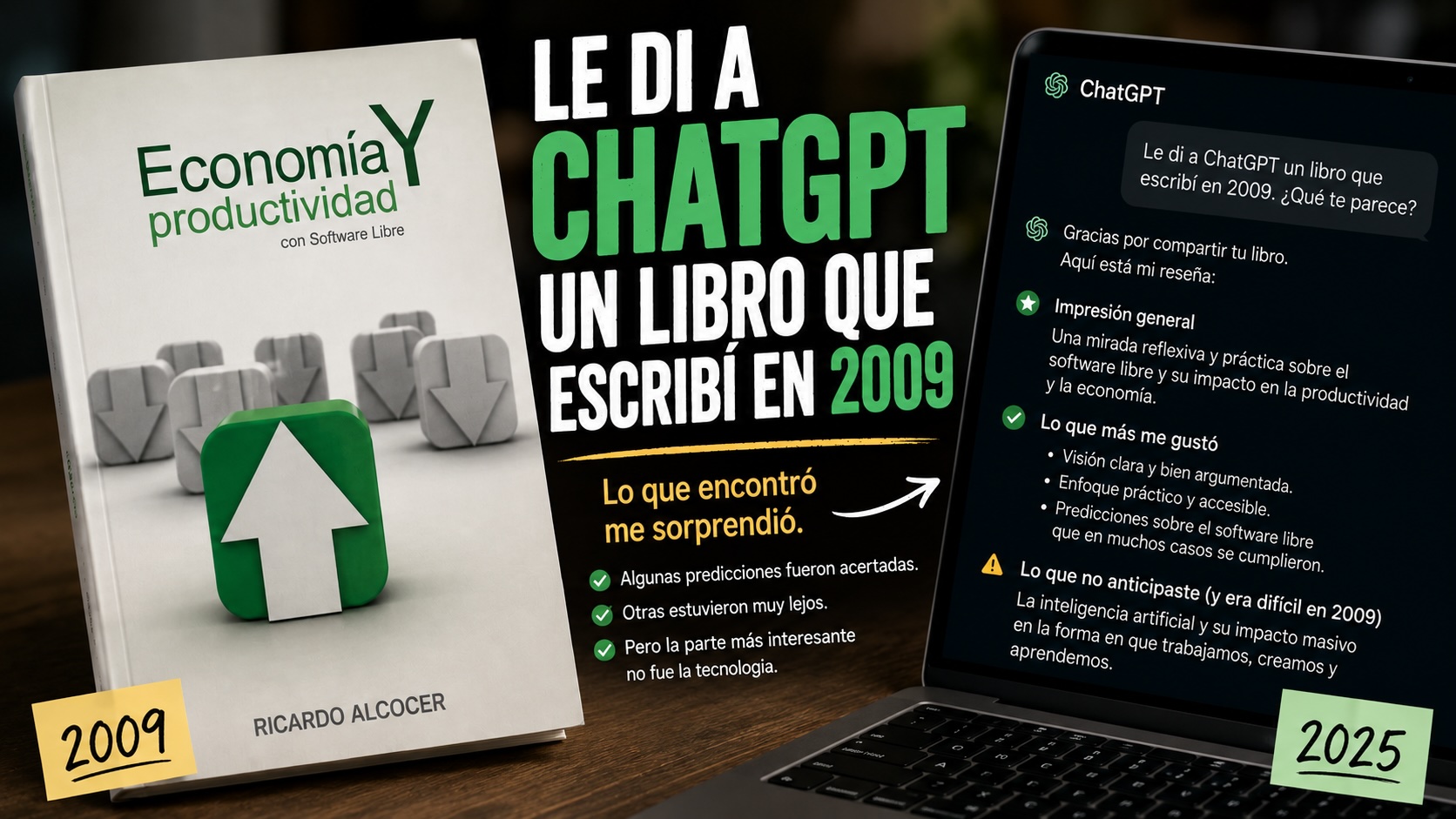
A few weeks ago I uploaded a PDF of a book I wrote in 2009 to ChatGPT and asked it a simple question:
"What do you think?"
The book is called Economía y Productividad con Software Libre — "Economy and Productivity with Free Software."
Back then I wrote a blog called Tecnología Libre, gave talks about Linux, Firefox, OpenOffice and other free-software tools, and was convinced the Open Source movement was going to transform the tech industry.
Sixteen years later I decided to read it again, and the experience was strange — less like rereading a book, more like opening a time capsule.
Many of the technology predictions aged surprisingly well. Free software became a foundational part of the Internet, Linux conquered the servers, remote work went mainstream, and the barriers to starting a company or launching a project dropped dramatically. In many ways the industry went exactly where I imagined it would.
What struck me most, though, was everything I didn't see coming.
The book spends more than 150 pages talking about software: Linux, Apache, PHP, MySQL, Firefox, productivity, online collaboration. And not one relevant prediction about what would become the most important technology story of the next two decades: artificial intelligence.
I don't hold it against my 2009 self — almost nobody saw it coming in the form it arrived. Back then, when we talked about artificial intelligence, we pictured something out of science fiction: a computer you could have a conversation with. That was the dream. What I never imagined was that sixteen years later I'd be uploading my book to one of those machines to ask for its opinion.
There's something absurd about the whole situation: a human writes a book, a machine reads it and offers an opinion, and the same human ends up writing an article about the machine's opinion.
But the most curious part wasn't technological. It was reaching the author bio at the end of the book.
Reading it today, you'd think the author had already done everything that mattered: he had a career, a company, a published book, speaking engagements, and fairly firm opinions about how the world worked. The truth is that many of the most important experiences of my life hadn't happened yet. Silicon Valley, Appcelerator, Contentful, the move to Mexico City, a good part of the articles I write today — all of that came later.
The bio reads like it was written by someone closing out a chapter, when in reality he was barely starting another one.
I think that was the most interesting lesson of rereading that book. At 37 I thought I had a pretty good sense of where technology was headed, and in several cases I was right. What I didn't understand was how much living I still had left.
I suspect this happens to all of us: we tend to overestimate how finished we are. We look at our current life and assume we already know the general shape of the rest of the story. Then ten or fifteen years go by, and we discover the main character was still under development.
In the end, ChatGPT didn't teach me anything particularly new about free software. It gave me something more interesting: the chance to spend an afternoon talking with a version of myself that had been waiting inside a PDF for sixteen years. He got some predictions right and missed others completely.
But after rereading him, I liked the guy.
That same book resurfaced recently in a different way, when an unexpected download got me thinking about the relationship we have with our creations.
The era that produced it left another story too: the free-technology institute I founded in San Juan out of sheer frustration.
And that artificial intelligence I didn't see coming is now rewriting my own craft — something I wrestled with in Vibe Coding: The Death of a Craft.
📬 Enjoyed this article?
Subscribe for the stuff that doesn't make it onto the blog — half-finished ideas, what I'm reading and listening to, behind-the-scenes notes, and the occasional rabbit hole. No spam, just things worth your time.